
The digital visibility ecosystem has undergone a fundamental architectural transformation. For over two decades, the primary objective of search engine optimization (SEO) was to secure top-ranking positions within a list of blue links or a localized map pack, thereby driving human click-through traffic to a target web property. However, by the year 2026, the mechanics of how consumers and business-to-business (B2B) buyers discover, evaluate, and select local services have profoundly fragmented. Generative artificial intelligence systems such as OpenAI’s ChatGPT, Perplexity, Anthropic’s Claude, and Google’s Gemini-powered Ask Maps now synthesize data to provide direct, conversational answers, frequently eliminating the need for users to click through to an external website.
Market data indicates that as of early 2026, 45% of consumers utilize platforms like ChatGPT to discover local businesses, representing a massive acceleration from a mere 6% adoption rate in January 2025. Concurrently, traditional search engine query volume is projected by industry analysts to decline by 25% by the end of 2026, with an estimated 58% to 60% of Google searches ending without a single subsequent click. This evolution has necessitated a strategic bifurcation in digital growth methodologies: traditional Local SEO and Generative Engine Optimization (GEO). Understanding the precise intersection, the fundamental differences, and the technical execution required for both disciplines is no longer optional for service businesses operating in highly competitive, geographically dense markets such as Miami, Fort Lauderdale, and Orlando. This comprehensive analysis details the strategic frameworks and technical implementations required to dominate both traditional search engine results pages (SERPs) and AI-driven answer engines in the modern digital economy.
The Architectural Differences: Local SEO vs. GEO
To successfully navigate the 2026 digital landscape, organizations must draw a distinct line between optimizing for digital discovery (traditional SEO) and optimizing for machine comprehension and algorithmic citation (GEO). While the two disciplines share underlying foundational elements—such as technical website health and the presentation of authoritative content—the mechanisms by which they generate visibility are fundamentally different.
Traditional Local SEO: The Baseline of Proximity and Discovery
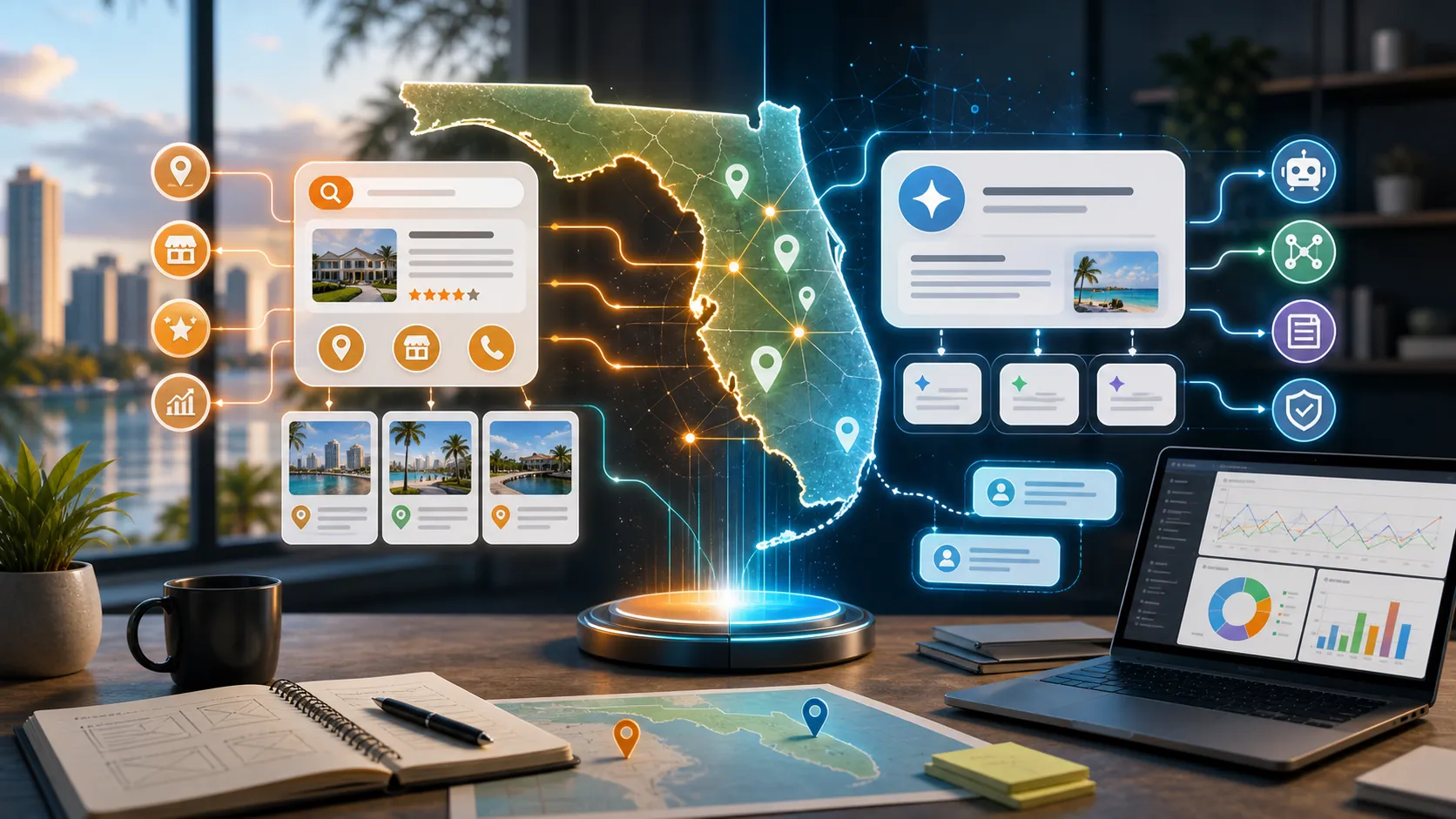
Local SEO and GEO visibility loop

Local SEO remains a vital, foundational discipline centered squarely on human searchers seeking immediate, geographically relevant solutions. It is optimized for location-based queries tied heavily to urgency and proximity, such as inquiries for a “commercial plumber in Hialeah” or a “Miami B2B software developer”. Success within the realm of local SEO has traditionally been measured by quantitative metrics: keyword ranking positions, organic traffic volume, and
website click-through rates. The structural pillars of Local SEO revolve around establishing geographical relevance and real-world trust. The optimization of the Google Business Profile (GBP) remains the central nervous system of local search, requiring strict consistency of the business’s Name, Address, and Phone Number (NAP) across the entire digital ecosystem. On-page optimization requires the strategic integration of geographic keywords and defined service areas into metadata, title tags, and localized landing pages. Furthermore, traditional local SEO relies heavily on building domain authority through the acquisition of local citations in directories and securing inbound backlinks from regionally relevant domains, alongside the continuous generation of positive customer reviews to influence visibility within the local map pack. Even in an AI-first paradigm, local SEO is not obsolete; it continues to thrive for queries possessing clear local intent and urgency. It acts as the baseline infrastructure that ensures a business is physically verifiable by the algorithms that power modern search.
Generative Engine Optimization (GEO): The Science of AI Citation
Generative Engine Optimization (GEO)—a term frequently utilized interchangeably with Answer Engine Optimization (AEO)—is the sophisticated practice of structuring a brand’s digital presence, content architecture, and backend data so that large language models (LLMs) can seamlessly understand, trust, and explicitly cite the business when generating synthesized responses. While traditional SEO targets a human audience scanning a ranked list of options, the primary “reader” in GEO is a machine. Artificial intelligence models do not retrieve and display a single webpage; instead, they extract, parse, and synthesize information from across multiple digital sources to form a consensus before generating an answer. Consequently, success in GEO is not measured by traffic volume, but rather by brand mentions, algorithmic attributions as a definitive source of truth, and explicit recommendations curated directly by the AI system. The paradigm shifts from earning the best storefront on a crowded street (SEO) to becoming the definitive entity that a virtual tour guide recommends whenever a user asks for a solution (GEO).
Structural Comparison Matrix
To elucidate the operational differences between these two methodologies, the following table presents a comparative analysis of their core strategic elements.
| Strategic element | Traditional local SEO | Generative Engine Optimization |
|---|---|---|
| Primary objective | Rank highly in SERPs and local map packs to drive user clicks and website traffic. | Be cited, mentioned, or recommended as the definitive source within AI-generated answers. |
| User search behavior | Short, keyword-dense queries such as “best marketing agency Miami.” | Natural-language conversational questions with situational constraints. |
| Algorithmic ranking mechanism | Domain authority, backlink velocity, keyword relevance, and geographic proximity. | Multi-source consensus building, structured data extraction, and deep entity trust. |
| Content architecture focus | Comprehensive long-form guides designed to hold human attention and capture search volume. | Modular, answer-first structures, direct definitions, structured tables, and factual data blocks. |
| Technical priority | Page load speed, XML sitemap crawlability, and mobile-responsive design. | Advanced JSON-LD schema, semantic HTML hierarchy, and knowledge graph integration. |
| Performance measurement | Google Search Console metrics, keyword rankings, and organic traffic analytics. | Brand mention tracking, AI citation frequency, and multi-platform visibility audits. |
The Transformation of Google Search: Ask Maps and Immersive Navigation
In March 2026, Google deployed a massive architectural update to its local search ecosystem with the introduction of Ask Maps, paired with Immersive Navigation. This feature fundamentally altered the local discovery journey by integrating the Gemini AI model directly into the Google Maps application. Prior to this update, users relied heavily on typing short keywords into the search bar. The new interface allows users to tap an “Ask Maps” button and submit complex, natural language prompts. A user can now query the system with highly specific constraints, such as, “Find a highly rated IT automation consultant near Fort Lauderdale that specializes in n8n workflows and has remote capabilities”. The Gemini model processes this intricate query against an immense dataset comprising over 300 million places and 500 million community contributors worldwide. The output is an AI-generated narrative summary that contextualizes recommendations, paired with a customized, interactive map view.
Algorithmic Evaluation of Local Entities in Ask Maps
To achieve visibility within Ask Maps, businesses must recognize that Google is no longer merely ranking individual webpages; the system is verifying and recommending real-world entities. The AI evaluates entities based on highly specific, qualitative data points. It performs deep sentiment and semantic analysis on customer reviews, extracting service confirmations, attributes, and location context from the complete review text. A generic five-star review carries less algorithmic weight than a detailed review stating, “The custom AI chatbot development provided by this agency integrated flawlessly with our existing CRM, saving us hours of manual data entry.” When a user queries Ask Maps for CRM integration specialists, that review text can become validation.
Google has also integrated visual AI signals into local evaluation. The system can scan uploaded, geotagged images to verify the services claimed on a business profile. Authentic photos of real service delivery, such as server racks for an IT firm or branded vehicles near local landmarks, help cross-reference visual data with stated service categories. Profile completeness remains essential because Gemini relies heavily on structured Google Business Profile data. Profiles with outdated hours, incomplete fields, or vague service categories are routinely excluded from nuanced recommendation scenarios.
Optimizing for Non-Google LLMs: The Ecosystems of ChatGPT and Perplexity
While Google continues to dominate traditional web search, generative AI search engines operate on entirely different data pipelines and retrieval methodologies. A business that is optimized flawlessly for Google Maps may remain entirely invisible to a prospect utilizing ChatGPT or Perplexity for commercial research.
The ChatGPT Local Search Architecture
Understanding how ChatGPT processes local intent queries is critical for modern digital strategy. ChatGPT relies on a sophisticated tech stack that processes “near me” queries using IP-based geolocation to determine user proximity without requiring explicit location sharing. When parsing natural language queries for local businesses, ChatGPT depends heavily on external application programming interfaces (APIs) to source localized data. Analysis reveals that upwards of 70% of ChatGPT’s local results are sourced directly from the Foursquare Places API, which aggregates data from user contributions and partner integrations. The system then augments this foundational Foursquare data with real-time information retrieved via Bing Search. Therefore, establishing and maintaining an accurate, heavily enriched Foursquare listing is a critical, yet frequently overlooked, GEO tactic for local businesses aiming to capture ChatGPT traffic.
The Mechanism of Multi-Source Consensus Building
Artificial intelligence systems can generate false or misleading information, so they look for consensus across multiple sources before making confident recommendations. Before an LLM recommends a Miami-based technical partner, it cross-references the web. If the business claims specialized expertise on its own website, the AI system looks for external validation. Consistent positioning across independent platforms creates the consensus signal required for citation. Without broad validation, AI systems treat brand claims skeptically and may recommend competitors with a more verifiable digital footprint.
Building multi-source consensus requires activity across multiple touchpoints. Community platforms such as Reddit and Quora can provide authentic discussion signals when participation is genuine and authoritative. Video content is also useful because AI systems can extract dense semantic text from transcripts, descriptions, and chapters. A walkthrough of a software development process or business automation workflow gives algorithms evidence of expertise. Profile consistency is non-negotiable: Crunchbase, LinkedIn, G2, Capterra, local directories, and the primary website should all reflect the same service positioning, pricing structure, and target market.
Content Architecture: E-E-A-T and The Big 5 Framework
Both the traditional Google Search algorithm and modern generative AI models heavily prioritize the concept of E-E-A-T: Experience, Expertise, Authoritativeness, and Trustworthiness. To succeed in 2026, corporate content must transition away from generic, keyword-stuffed marketing copy toward a framework of radical transparency and verifiable expertise. The most effective, proven framework for answering complex buyer questions and capturing AI citations is known as “The Big 5.” This framework represents the five core topics that high-intent B2B and local buyers actively research prior to making a purchasing decision. By addressing these topics directly, businesses provide exactly the type of structured data that AI models seek to extract. The Big 5 content topics include:
- Cost and Price: Organizations must explain the factors that influence investment, whether the service is a custom AI chatbot, an SEO retainer, or an automation build. Addressing pricing directly builds trust, and AI models often extract pricing tables to answer budget questions.
- Problems and Limitations: Proactively addressing drawbacks, risks, and common failures earns credibility. For example, an article explaining why rigid workflow automation fails where autonomous AI agents succeed gives AI models nuanced, high-expertise material to summarize.
- Versus and Comparisons: Human buyers and AI models rely on comparative analysis. Structured side-by-side comparisons, such as “Make.com vs. n8n for enterprise-scale AI workflows,” feed systems that parse and summarize comparative data.
- Reviews and Fit: Honest case studies, industry reviews, and clear “not a fit” guidance establish trust. AI systems use this transparency to match businesses with better-qualified prompts.
- Best in Class: Objective lists of top solutions or strategies within a local market or technical niche capture searches using words like “best,” “top,” and “fastest.” Generative models reference these lists when synthesizing recommendations.
When structuring content around The Big 5, formatting is as important as prose. Content must support answer extraction with direct definitions, compact summaries, and structured data near the top of the article before deeper context and examples.
Technical Infrastructure for GEO: Schema Markup and Semantics
The bedrock of Generative Engine Optimization is robust technical infrastructure. Large language models are highly efficient at parsing cleanly structured data. If a website forces an AI crawler to expend computational resources guessing the context of a page, the AI will bypass the site and extract answers from a competitor whose digital infrastructure utilizes proper markup.
Advanced JSON-LD Schema Markup Integration
Schema markup is a standardized vocabulary—maintained collectively at Schema.org—that explicitly translates human-readable web content into machine-readable code. Industry data shows that over 75% of high-performing GEO-optimized pages utilize advanced schema to feed precise data to AI systems. For a Florida-based digital growth technical partner, deploying multiple, stacked layers of schema is mandatory for maximum visibility. The foundation begins with Organization and LocalBusiness Schema. This code establishes the business as a verified entity, linking the brand name to a precise physical location, distinct contact points, and associated social media profiles. For service-area businesses serving a wide geographic footprint encompassing Miami, Fort Lauderdale, Orlando, and remote clients, the utilization of the areaServed property within the LocalBusiness schema is critical for signaling geographic relevance to the algorithms. An example of an advanced, customized JSON-LD snippet for a technical service provider is detailed below:
{
  "@context": "https://schema.org",
  "@type": "LocalBusiness",
  "name": "Avaab Razzaq - Digital Growth Technical Partner",
  "image": "https://avaabrazzaq.com/brand-assets/logo.png",
  "description": "Expert technical partner specializing in full-stack web development, AI automation workflows (n8n), and advanced Local SEO/GEO strategies for scaling businesses.",
  "url": "https://avaabrazzaq.com",
  "telephone": "+1-555-019-8372",
  "areaServed": ["Miami", "Hialeah", "Fort Lauderdale", "Orlando"],
  "sameAs": [
    "https://www.linkedin.com/in/avaabrazzaq",
    "https://twitter.com/avaabrazzaq"
  ]
}
Beyond entity definition, FAQPage Schema is an incredibly potent tool. Generative engines actively hunt for Q&A formats to satisfy user prompts. By wrapping Frequently Asked Questions in FAQPage schema, a business dramatically increases the probability of its exact wording being lifted directly into an AI Overview or a ChatGPT response. Furthermore, organizations offering highly specialized, technical integrations must deploy Service and HowTo Schema. For disciplines such as Model Context Protocol integration or complex LLM consulting, Service schema explicitly defines the parameters of the offering to the machine. Concurrently, HowTo schema breaks down technical processes into discrete, sequential steps, providing the exact structured format that AI agents prefer when summarizing tutorials or methodologies.
Semantic HTML and Content Modularity
Beyond the implementation of schema, the underlying HTML structure of the website itself must be strictly semantic. AI models rely heavily on strict heading hierarchies (nesting H1s to H2s to H3s logically) to understand topical relationships and the relative importance of different content blocks. Content must be authored with modular formatting in mind. Technical data should be presented in bulleted lists for features, numbered lists for step-by-step processes, and HTML tables for product or service comparisons. AI systems demonstrate exceptionally high accuracy when extracting tabular data, making tables a primary asset for GEO. Additionally, the reliance on client-side rendering must be managed carefully. While modern web applications frequently rely heavily on JavaScript for dynamic user experiences, core informational content intended for algorithmic ingestion must be accessible within the raw HTML payload. Ensuring that text is present without requiring the execution of complex scripts guarantees that AI crawlers, such as OpenAI’s GPTBot and Anthropic’s ClaudeBot, can index the data efficiently and accurately.
Automating the GEO and SEO Ecosystem with n8n
Managing the compounded complexities of modern traditional SEO, technical GEO, local market citation tracking, and lead routing manually is no longer a viable operational model for high-growth businesses. As forward-thinking companies transition to AI-first operational models, the deployment of becomes the central nervous system driving digital marketing and operational efficiency. The open-source automation platform n8n represents a massive paradigm shift in how technical teams execute marketing and data operations. Unlike rigid, traditional no-code platforms (such as Zapier), n8n offers an architecture that blends visual node-based design with code-level
flexibility. This allows developers to orchestrate multiple LLMs, integrate proprietary databases, and construct complex, multi-step decision-making trees that can run autonomously.
Advanced Operational Use Cases for n8n in Digital Growth
RAG-Powered Content Creation Pipelines
Generating the hyper-localized, expert-level content required for both SEO and GEO on a consistent basis presents a massive bottleneck for most marketing teams. An advanced n8n workflow can automate this entire lifecycle utilizing Retrieval-Augmented Generation (RAG) methodologies. The architecture of such a workflow operates sequentially:
- Trigger Mechanism: A new content concept, such as “The impact of voice search on local SEO trends in Orlando,” is logged into a project management tool like Notion or Airtable.
- Research Agent Deployment: An AI node powered by a model such as Claude or GPT-4o acts as a research agent. It searches external APIs and queries an internal vectorized knowledge base to extract factual data, current statistics, and required local context.
- Drafting Agent Execution: A specialized writing agent processes the research data into an article draft with semantic SEO terms, structured formatting, and required schema variables.
- Optimization and Editing Agent: The draft is routed through a secondary editing agent that checks brand voice, semantic clarity, and GEO formatting, including direct answers and short paragraph structures.
- Approval and Publishing Gate: After human approval through Slack or a similar interface, the n8n workflow formats the content, publishes it to the CMS, and distributes optimized excerpts across connected social channels.
Local Review Management and Sentiment Analysis
For businesses aiming to optimize for Google Ask Maps, maintaining pristine review quality and a high response rate is paramount. Utilizing logic embedded within an n8n workflow, an organization can continuously monitor inbound reviews across Google Business Profile, Yelp, and specialized B2B directories. The workflow extracts the review text and passes it to an LLM for rapid sentiment analysis. If the sentiment is classified as highly positive, the system can trigger an automated, contextually relevant response thanking the customer. If the sentiment is classified as negative or requires escalation, the workflow immediately routes an alert to the customer success operations team for immediate human intervention, mitigating reputation damage.
Automated Competitor Citation Tracking
To maintain the critical multi-source consensus required for GEO, businesses must monitor their digital footprint against competitors. An n8n workflow can systematically track brand mentions and query AI search platforms at scheduled intervals to see whether the business is being cited for core topics. This visibility data can then be logged into a centralized analytics dashboard so technical partners can adjust content strategy as algorithms shift.
Intelligent Lead Reactivation and Routing
Applying artificial intelligence to inbound lead operations dramatically increases conversion rates and minimizes lead leakage. When a local business inquiry is submitted via a website form, an n8n AI agent immediately evaluates the request, scoring the lead based on intent signals and budget parameters, while simultaneously enriching the contact data utilizing firmographic APIs. The system then routes the highly qualified lead directly into the CRM and initiates an AI-driven SMS or email follow-up sequence, ensuring immediate engagement while the prospect’s intent remains high.
High-Performance Web Development for AI Ecosystems
The technical infrastructure housing a business’s content strictly dictates its algorithmic success. Whether constructing localized landing pages, sophisticated B2B portals, or robust SaaS platforms, the architecture must prioritize absolute machine readability and raw computational performance.
Core Web Vitals and Latency Optimization
Search engine algorithms and AI crawling bots alike severely penalize latency. Ensuring a sub-3-second page load time, optimizing the Largest Contentful Paint (LCP) metric, and minimizing Cumulative Layout Shift (CLS) are foundational, non-negotiable requirements. Fast-loading, highly mobile-responsive landing pages are critical components for local search success, as they directly influence the behavioral engagement metrics (such as dwell time and bounce rate) that Google uses to validate entity quality.
Building SaaS MVPs and Integrating Native AI
For startups and service businesses looking to scale their operations or productize their services, developing proprietary internal tools or client-facing dashboards provides a massive market advantage. Investing in full-stack web development allows organizations to encapsulate their unique operational expertise into scalable software. By integrating native AI capabilities into these builds, such as leveraging LLM integration and API consulting services, businesses can offer their clients dynamic reporting environments, automated analytics processing, and intelligent workflow management systems. Custom web applications must be meticulously engineered with secure data pipelines, particularly when handling sensitive local client data, healthcare information, or proprietary automation scripts. Deploying self-hosted solutions like n8n or utilizing robust, compliant cloud infrastructure ensures absolute data privacy and adherence to strict regulatory compliance frameworks.
Navigating the Nuances of the Florida Market Dynamics
The state of Florida, particularly the sprawling Miami and Orlando metropolitan statistical areas, features uniquely dense and fiercely competitive digital ecosystems. The concentration of professional law firms, specialized medical practices, luxury real estate developers, and commercial service contractors makes generalized, state-wide SEO highly ineffective.
Executing Hyper-Local Optimization Strategies
To successfully penetrate these saturated markets, businesses must deploy targeted, hyper-local optimization strategies. Targeting broad, overarching terms such as “Florida automation agency” yields low conversion rates and massive competition. Instead, businesses must optimize their content and schema for high-intent, neighborhood-specific queries. Formulating strategies around terms like “AI workflow consulting in Brickell,” “B2B web development near Hamlin Town Center,” or “commercial technical SEO in Southwood” captures users at the exact moment of commercial intent. Active integration within the local community provides the strong geographic signals that algorithms reward. Sponsoring or participating in local technology events—such as the eMerge Americas AI + Deep Tech summits scheduled for April 22-24, 2026, or the POSSIBLE 2026 AI Verse event in Miami Beach occurring April 27-29, 2026—generates authoritative, hyper-local digital footprints. Securing brand mentions and backlinks from regional tech directories, local university programs, and neighborhood associations builds the hyper-local authority required to dominate the map pack. For organizations serving multiple counties across the state, creating dedicated, high-value service area pages is mandatory. However, these pages cannot be thin, duplicated content blocks where only the city name has been dynamically swapped. Search engines penalize this behavior. High-performing location pages must feature genuine local context, localized FAQ sections addressing region-specific challenges, and structured AreaServed schema mapping explicitly to local ZIP codes to clearly define the operational footprint to the AI.
Common Mistakes and Strategic Roadblocks
As companies race to adapt to the realities of the 2026 digital landscape, several critical execution errors routinely undermine capital investments and stall growth initiatives.
- Abandoning Traditional SEO Foundations: GEO relies on the domain authority and trust signals established by traditional SEO. Ignoring website architecture, backlink profile health, or crawlability in favor of AI citations can collapse overall visibility. The two disciplines must operate together.
- Destructive Content Guttering: In an attempt to become “AI-friendly,” marketing teams often rewrite historically well-ranking articles from scratch. This can strip away established keyword relevance and destroy organic traffic. A safer approach is to add direct answer blocks, clearer sections, and FAQ schema to strong existing pages.
- Fragmented Data and Inconsistent Entities: Different business hours on Yelp, an outdated address on Foursquare, and a mismatched phone number on Facebook reduce an LLM’s confidence in recommending the business. Entity consistency is the foundation of AI trust.
- Algorithmic Keyword Stuffing: Forcing phrases like “best Miami SEO AI automation web developer in Miami Florida” into copy harms readability and brand perception. Modern AI systems prioritize semantic clarity and contextual relationships over crude keyword density.
- Neglecting the Mobile Experience Architecture: Many urgency-driven local searches start on mobile devices. A non-responsive page with unreadable text or difficult CTAs creates negative behavioral signals and undermines rankings.
Strategic Decision Matrix: Build, Automate, or Optimize
Determining the exact point in a company’s growth cycle at which to transition from internal, manual efforts to partnering with a specialized technical expert is critical for maintaining operational momentum and capital efficiency.
-
When to Build: If an organization is currently relying on fragmented spreadsheets, generic out-of-the-box templates, or outdated legacy software that actively hinders client acquisition and data management, it is time to build. Comprehensive full-stack web development ensures the creation of proprietary, high-speed digital assets tailored exactly to the business’s specific operational workflows and market positioning.
-
When to Automate: When internal teams find themselves spending more than 10 hours a week manually copy-pasting data across disconnected SaaS systems, generating routine performance reports, or manually responding to initial top-of-funnel lead inquiries, automation becomes an absolute imperative. Implementing AI workflow automation, such as n8n orchestrations or custom LLM agents, eliminates operational bottlenecks, ensures zero lead leakage, and frees human capital to focus exclusively on high-value, strategic interactions.
-
When to Optimize: If organic traffic has plateaued, if the business has disappeared from Google’s AI Overviews, or if aggressive local competitors are consistently capturing primary map pack real estate, immediate optimization is required. Deploying advanced technical SEO and GEO methodologies restores digital visibility, aligns the brand’s data with modern AI pipelines, and ensures the entity is algorithmically presented as the definitive local authority.
Conclusion
The transition from a link-centric digital economy to an answer-centric AI ecosystem demands a fundamental, structural upgrade in how Florida businesses architect their digital presence. Relying solely on outdated keyword density strategies, thin location pages, and basic directory listings is no longer sufficient to secure visibility and drive revenue in exceptionally dense markets like Miami, Fort Lauderdale, and Orlando. To thrive in 2026, service businesses, rapidly scaling startups, and established B2B organizations must adopt a unified, highly technical approach.
This methodology requires laying the ultimate technical groundwork with high-performance, semantic web development, establishing verifiable multi-source consensus through Generative Engine Optimization, and scaling internal marketing and sales operations via advanced AI automation systems like n8n. Organizations that successfully structure their data for rapid machine comprehension, while simultaneously maintaining deep, localized, and transparent value for human readers, will consistently outperform competitors who remain reliant on legacy tactics.
Navigating the compounded complexities of advanced schema markup, multi-agent LLM integrations, and hyper-local SEO data structuring requires absolute precision, technical depth, and strategic foresight. For businesses seeking to dominate local search ecosystems, implement intelligent automation workflows, or engineer robust, scalable software solutions, securing a dedicated technical partner represents the ultimate competitive advantage in the modern landscape. Schedule a discovery call to discuss how to position your organization for sustainable, AI-driven digital growth.
Works Cited
-
SEO vs. GEO: What to Know About Getting Found in 2026 - IMPACT
-
GEO vs SEO: Which Strategy Wins for Local Business Growth in 2026? - PageOnePower
-
Google Maps Ask Maps: How Gemini AI Changes Local Search (2026) - ALM Corp
-
SEO vs. GEO: What Small Businesses Need to Know in 2026 - Moxie Creative
-
18 Common Local SEO Mistakes And How To Avoid Them in 2026 - Connectica LLC
-
Local SEO vs GEO for Regional Brand Visibility – Augusto Digital
-
Best Local SEO Strategies For Miami Business - Ultimate Guide - Q-Tech
-
What’s the Difference Between SEO and Local SEO in the Age of AI Search? - EDealer
-
A SIMPLE GUIDE TO LOCAL SEO FOR SMALL BUSINESSES IN 2026 - SARMLife
-
Miami Local SEO Secrets 2026: Rank #1 on Google - SpotCodes Technologies
-
Miami SEO Company | 20+ Years, Proven Local Results - Connectica LLC
-
Local SEO in 2026: Trusted Identity Beats Keywords In AI Search - Elvin Web Marketing
-
The Ultimate Guide to Generative Engine Optimization (GEO) | by Chinedum Azuh | Medium
-
AI Search Optimization: How to Get Cited by ChatGPT, Perplexity …
-
Local SEO & AEO Trends for 2026: AEO, AI Search & Local Visibility - Knapsack Creative
-
The Ultimate GEO Checklist: 12 Steps to Optimize Your Brand - Onely
-
Search Everywhere Optimization: What Is SEO, GEO, and AEO? | Digital Marketing Institute
-
Ask Maps in Google Maps – When Local Search Meets Gemini AI - Glenn Gabe
-
Google Maps just dropped its biggest update in over a decade. - Reddit
-
Google Ask Maps Explained: How AI Recommendations Change Local SEO - ALM Corp
-
Google Maps SEO in 2026: Rank Higher With Proven Local Strategies
-
Local Business AI Search Strategy: Dominating ChatGPT for “Near …
-
AI Search Optimization: Rank in ChatGPT, Perplexity & Gemini 2025 - Dcrayons
-
8 Powerful n8n Workflows with AI for Business Efficiency - Scalevise
-
n8n Guide 2026: Features & Workflow Automation Deep Dive - HatchWorks AI
-
n8n AI Automation Workflows: How to Build Smart, Scalable Automations in 2026
-
n8n Content Creation Workflows 2026: From Idea to Multi-Platform Publish | Sacesta Blog
-
How AI Is Changing Local Marketing for Central Florida Small Businesses in 2026 | Around My Town
-
SEO or GEO: How To Adjust Your Local SEO Strategy For 2026 - Optic Marketing Group
-
AI Verse at POSSIBLE 2026 | Driving Marketing Forward in Miami
-
How to Build an AI Agent With n8n in 2026: A Step-by-Step Guide - Robiz Solutions