
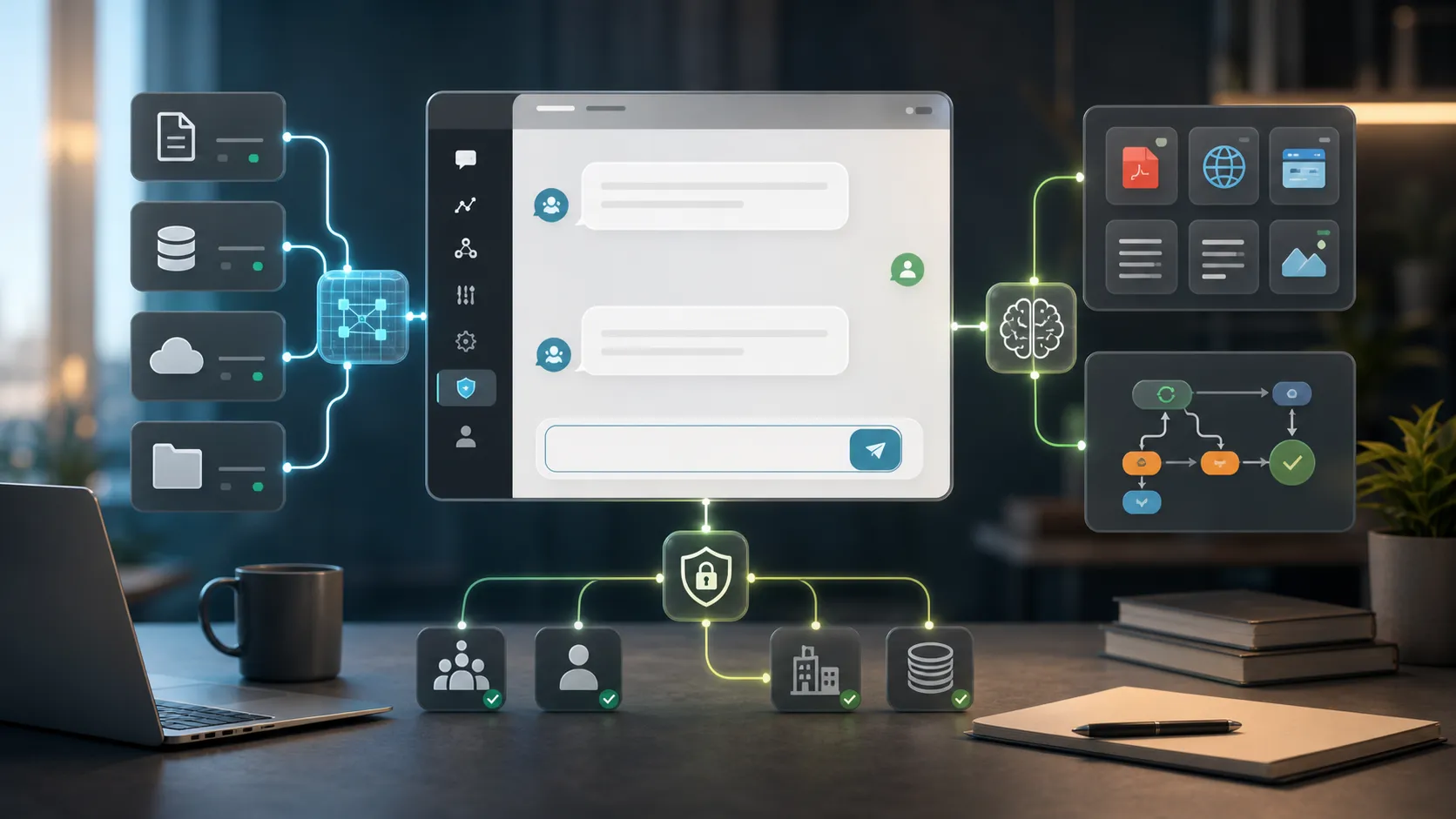
The enterprise technology landscape has crossed the threshold from experimental curiosity to systemic integration. As artificial intelligence models mature, the early fascination with consumer-grade public large language models has shifted into a more strategic phase of commercial deployment.
Modern organizations are no longer satisfied with the generalized, often unpredictable outputs of standard public chatbots. They need private, custom-tailored AI interfaces that act more like specialized digital employees: systems that can securely process proprietary data, interact with legacy enterprise software, and drive operational efficiency without exposing sensitive information to public model training datasets.
At the same time, the digital visibility and client acquisition ecosystem is changing. Traditional search engine optimization is being supplemented by Generative Engine Optimization, or GEO. Gartner has forecasted that traditional search engine query volume could decline by 25% by 2026 as users rely more heavily on AI-powered answer engines and virtual chatbots for direct answers.
That creates a dual mandate for business leaders. They need to automate internal workflows with custom AI interfaces, and they need to restructure their external digital presence so their brand can be recognized, trusted, and cited by AI models acting on behalf of prospective clients.
This guide breaks down the architecture, economics, deployment models, Model Context Protocol strategy, GEO implications, and Florida market applications behind custom ChatGPT-style interfaces for business.
The Enterprise Evolution of AI
A business-grade custom AI interface is not just a new skin on a public chatbot. It is a secure, isolated digital ecosystem built around a company’s operating model, internal data, compliance requirements, and brand voice.
Instead of relying only on generalized intelligence from the public internet, companies can build private systems with deep context about their customers, standard operating procedures, products, policies, and internal documentation. The goal is not novelty. The goal is controlled automation that can be trusted in real business workflows.
This is why the strongest custom AI systems are designed as operational infrastructure. They have defined data boundaries, role-based access, logging, escalation rules, and integration points with the systems employees already use.
The Architectural Foundations of Custom AI Interfaces
To turn a general model into a useful corporate asset, teams usually need several modular layers working together.
Base Model Selection
The first layer is the foundational model. A business may choose OpenAI’s GPT-4o, Anthropic’s Claude models, Google’s Gemini models, or an open-source model such as Llama or Mistral depending on the workload.
The right choice depends on reasoning quality, latency, cost, privacy needs, hosting requirements, and how much control the organization needs over model behavior.
Retrieval-Augmented Generation
The second layer is the knowledge system. Retrieval-Augmented Generation, often shortened to RAG, connects the AI interface to verified business data such as:
- Standard operating procedures
- Product catalogs
- Sales enablement documents
- HR policies
- Customer support articles
- Historical support tickets
- Internal training materials
The documents are cleaned, chunked, embedded, and stored in a searchable index. When a user asks a question, the system retrieves relevant excerpts and passes them into the model so the answer is grounded in approved company information.
This matters because a custom chatbot should not guess about refund policies, inventory status, legal procedure, or account information. A strong RAG pipeline lowers hallucination risk by forcing the AI system to answer from controlled source material.
Prompt Engineering and Behavioral Boundaries
The third layer defines how the AI should behave. This includes tone, escalation triggers, compliance language, refusal behavior, and the boundary between what the system can answer independently and what should be routed to a human.
For example, a legal assistant may summarize deposition notes but refuse to provide unsupervised legal advice. A healthcare assistant may help route patient questions but avoid unapproved diagnostic claims. A sales assistant may qualify a lead but avoid promising custom pricing without approval.
APIs and Automation Frameworks
The fourth layer turns the interface from a passive knowledge base into an active digital worker. Through LLM integration, AI chatbot development, and AI workflow automation, the assistant can connect to systems such as:
- Salesforce or HubSpot
- ERP databases
- Help desk tools
- Inventory systems
- Scheduling platforms
- Billing systems
- Internal communication tools
- Custom operational dashboards
This is where the commercial value compounds. The AI can retrieve customer context, update records, create support tickets, summarize conversations, trigger workflows, and reduce manual coordination.
Security and Access Controls
The final layer is governance. A business-grade system needs authentication, role-based authorization, audit logs, data retention rules, and strict controls around which documents, tools, and actions each user can access.
This is especially important for regulated sectors that need SOC 2, HIPAA, ISO 27001, or similar compliance alignment. The interface should never have unrestricted access to sensitive corporate systems.

Operational Transformations and High-Impact Use Cases
When these layers are designed well, custom AI interfaces can create measurable operational improvements.
Customer Support Automation
Customer support is often the first use case because the workflow is repetitive, high-volume, and measurable. A custom AI assistant can answer tier-one questions, retrieve order status, raise support tickets, and route complex issues to the right team.
Instead of telling a customer to contact support, a properly integrated assistant can say, “I found your order, it shipped yesterday, and the tracking link is available here.” That is the difference between a chatbot that deflects work and an AI interface that resolves work.
Marketing and Content Operations
Fine-tuned or RAG-supported models can help produce campaign drafts, technical outlines, landing page copy, ad variations, and internal content briefs. The business benefit comes from combining speed with guardrails: the AI can work inside the company’s voice, positioning, and factual constraints.
The result is not unchecked generic content. The result is a faster editorial and marketing workflow where humans still own judgment, quality, and final approval.
Sales and Lead Nurturing
When connected to a CRM, a custom AI agent can qualify leads, summarize past interactions, identify buying intent, draft follow-up emails, and help account executives prepare for meetings.
This is particularly valuable when response speed affects conversion. A lead that waits hours for a manual follow-up may go cold. A system that routes, summarizes, and drafts immediately gives the sales team a cleaner starting point.
Internal Knowledge Management
Employees lose time searching through scattered folders, intranets, wikis, and message threads. An internal custom GPT can answer questions such as “What is the updated remote work policy?” or “Summarize the Q2 project risk notes.”
The strongest implementations include source citations and permission-aware retrieval, so users can verify answers and only access content they are authorized to see.
Project and Workflow Navigation
Custom AI interfaces can also summarize project status, prepare meeting agendas, identify blockers, turn meeting notes into tasks, and structure multi-department workflows. This is where AI moves beyond chat and into operational coordination.
Enterprise Deployment Strategies
Organizations moving toward AI-first operations need to decide how they will access and deploy foundational models. The three most common models are SaaS subscriptions, custom API deployments, and local or on-premises models.
| Deployment model | Typical cost structure | Best use case | Security and data sovereignty |
|---|---|---|---|
| SaaS subscriptions such as ChatGPT Plus, Team, or Business | Often $20 to $50 per user per month | Solo professionals, small teams, internal brainstorming, and standard web interface needs | Data crosses provider servers. Business tiers may offer no-training commitments and encryption. |
| Custom OpenAI, Anthropic, or Gemini API deployment | Variable pay-per-token usage, from light monthly costs to enterprise-scale spend | Custom applications, automated workflows, backend chatbot integrations, and controlled product experiences | Greater control over prompt routing, app logic, data handling, and retention policies depending on provider terms. |
| Local or on-premises open-source models | Significant hardware and IT cost, sometimes $8,000 to $15,000 or more before labor | Regulated industries, high-sensitivity data, defense, finance, legal, healthcare, and strict sovereignty requirements | Data can remain inside the corporate environment, but the organization owns infrastructure, patching, and operations. |
SaaS products are the easiest entry point. They work well for individual productivity, research, drafting, and early experimentation. But they can become limiting when the business needs custom interfaces, tool access, proprietary workflows, or fine-grained data controls.
API-based deployment gives developers control over the experience. It allows teams to build custom graphical interfaces, background automation, mobile features, and internal dashboards that are not constrained by the standard ChatGPT web interface. This is often the right path for production custom AI interface implementation.
Local deployment is the strongest privacy option, but it comes with higher operational burden. The organization must manage hardware, model hosting, security updates, monitoring, and performance tuning.
The Model Context Protocol Paradigm Shift
The biggest barrier to scaling custom AI inside enterprises has been integration complexity. Connecting an LLM to SAP, SQL databases, Jira, Slack, local files, CRMs, and proprietary systems traditionally required custom connectors for each tool and each AI framework.
That approach created an “N x M” integration problem: many tools multiplied by many AI clients. It was fragile, expensive, and hard to govern.
The Model Context Protocol, introduced by Anthropic in November 2024, addresses that problem by providing an open standard for connecting AI applications to external systems. It is often described as a USB-C-style standard for AI integrations because it gives developers a consistent way to expose tools, resources, and prompts to AI clients.
The Standardized Client-Server Architecture
MCP replaces ad hoc connectors with a client-server architecture based on JSON-RPC 2.0.
The MCP host is the application that contains the AI interface, such as a custom chatbot dashboard, internal agent server, or developer IDE. Inside that host, the MCP client manages protocol communication and routes requests. The MCP server is the bridge to an external system, such as a database, ticketing system, file store, or business application.
In practice, this means a team can build one MCP server for a system such as Jira or a proprietary database, then let multiple approved AI clients use that server through a standard protocol.
Benefits of MCP for Business AI
Implementing an architecture rooted in Model Context Protocol integration can solve several common enterprise AI problems.
First, it reduces integration fragmentation. Instead of building ten different connectors for ten different agents, the team builds a standardized server that can be reused.
Second, it improves governance. An MCP server can define exactly which tools, records, documents, and actions are available. A server can expose read-only access, require approval before writes, or log every tool call for compliance review.
Third, it can reduce context window overload. Early AI systems often loaded large tool descriptions and huge datasets into the model context before the model even knew whether they were needed. MCP allows tools and resources to be exposed more dynamically. Server-side filtering can summarize or sanitize data before it reaches the LLM, lowering token usage and improving latency.
For companies building AI agents across multiple departments, MCP is not just a developer convenience. It is a governance and cost-control strategy.
Generative Engine Optimization: The New Visibility Layer
While companies invest in internal AI automation, their buyers are using the same technologies to search for vendors, compare options, and make decisions.
The old digital growth question was, “Are we ranking on page one of Google?” The newer question is, “Are we being cited as a trusted source inside AI-generated answers?”
That shift is the reason businesses need Generative Engine Optimization. GEO focuses on making content understandable, trustworthy, and cite-worthy for AI answer systems such as ChatGPT Search, Perplexity, Gemini, and Google AI Overviews.
A Triple-Threat Optimization Strategy
SEO, AEO, and GEO overlap, but they do not optimize for the exact same interface.
| Optimization framework | Core objective | Primary mechanisms | Target interface |
|---|---|---|---|
| Traditional SEO | Capture legacy search traffic and rank pages for human search intent | Keyword relevance, backlinks, site speed, mobile performance, internal links, and technical crawlability | Standard search engine results pages |
| AEO, or Answer Engine Optimization | Win featured snippets, quick answers, and zero-click answer boxes | Question-based targeting, FAQ schema, concise summaries, and structured answers | Voice assistants and traditional search answer boxes |
| GEO, or Generative Engine Optimization | Influence LLM narratives and earn citations in synthesized AI answers | Semantic structure, entity clarity, E-E-A-T signals, citation patterns, schema, and offsite corroboration | ChatGPT Search, Perplexity, Google AI Overviews, Gemini, and similar systems |

The technical mechanics of GEO start with semantic structure. AI systems do not evaluate a page exactly like a human reader. They parse entities, headings, HTML structure, schema, links, and citations.
That means a visually polished page can still underperform if its underlying structure is unclear. Strong technical SEO and GEO implementation requires logical headings, semantic HTML, structured data, concise summaries, and source-backed claims.
GEO also depends on credibility signals. AI models are more likely to trust information that is corroborated across authoritative sources, reviews, transcripts, third-party directories, forums, and high-quality citations.
In advanced implementations, teams may also improve AI crawler experiences at the server or CDN layer by making structured content, JSON-LD, and clean summaries easier for AI agents to parse. That work must be handled carefully so human visitors and AI crawlers both receive useful, honest content.
The Financial Economics of Custom AI
A sober cost-benefit analysis is required before building a custom AI interface. Costs vary widely depending on system depth, integration complexity, compliance requirements, data quality, and model choice.
Capital Expenditures
The initial build cost usually falls into tiers.
| Custom AI architecture tier | Estimated development cost | Defining capabilities | Primary business use cases |
|---|---|---|---|
| Basic rule-based system | $5,000 to $30,000 | Hard-coded decision trees, basic NLP, single-language support, minimal integrations | Website FAQs, basic order tracking triage, small retail automation |
| Advanced AI-powered NLP bot | $20,000 to $60,000 | Intent training, multilingual support, sentiment analysis, richer conversation flows | High-volume support, lead generation, conversational commerce |
| Custom LLM or RAG interface | $60,000 to $200,000+ | Proprietary RAG pipelines, model orchestration, multi-system APIs, source-grounded responses | Enterprise knowledge bases, document synthesis, advanced technical support |
| Enterprise agentic AI | $200,000 to $1,000,000+ | Autonomous multi-step reasoning, compliance monitoring, complex authentication, deep enterprise integration | Banking, healthcare, legal, finance, and multinational operations |

Within those ranges, individual features create their own budget pressure. Intent engines, multilingual support, payment integrations, ERP connectors, and compliance workflows all add complexity.
The integration layer is often the largest hidden cost. Connecting to a standard CRM may be straightforward. Connecting to a legacy ERP, on-premises database, or compliance-heavy payment workflow can be far more expensive. This is one reason MCP standardization can produce real economic value.
Operational Expenditures
After launch, custom AI systems carry ongoing costs. API-driven architectures require token budgeting. Poorly optimized systems that pass excessive data into the context window can create avoidable monthly spend.
Maintenance also matters. A custom AI interface needs monitoring, prompt updates, retrieval tuning, source document refreshes, security patching, and periodic review of user logs. For regulated organizations, compliance audits and retention policies add additional recurring cost.
The financial goal is not to build the most elaborate system possible. The goal is to build the smallest reliable system that removes a real bottleneck, then expand as the ROI becomes visible.
Regional Impact: AI Automation in Florida
Custom AI adoption is shaped by local market needs. In South Florida, especially across Miami, Hialeah, Fort Lauderdale, and Orlando, the strongest use cases often appear in legal services, healthcare-adjacent operations, real estate, hospitality, logistics, and high-touch local service businesses.
Miami Legal Sector
The legal sector in South Florida is increasingly affected by AI. Law firms are using secure, legal-grade RAG interfaces to summarize deposition transcripts, support precedent research, and organize large volumes of case material.
For personal injury and medical malpractice practices, AI-assisted chronologies can help synthesize fragmented medical records so attorneys can focus on liability, causation, and damages.
The governance requirements are strict. Legal teams must protect client confidentiality, maintain competence, and avoid exposing sensitive casework to public chatbots. That makes private, permissioned AI systems more appropriate than generic consumer tools for serious legal workflows.
Luxury Real Estate and Hospitality
Miami Beach and the broader South Florida luxury market also create strong use cases for custom AI automation.
In high-end real estate, buyers increasingly expect intelligent property systems, personalized service, smart-home automation, and privacy-first digital experiences. In hospitality, AI can support multilingual concierge chatbots, dynamic room pricing, maintenance prediction, guest communication, and internal staffing workflows.
The opportunity is not only cost reduction. For premium experiences, AI automation can improve response speed, personalization, and operational consistency.
Common Mistakes and Strategic Considerations
The rush to adopt AI often leads organizations into expensive mistakes.
The first mistake is skipping discovery. Many companies jump directly into software engineering before mapping the real conversations, support requests, documents, and workflows the interface needs to handle. This creates expensive systems that answer rare questions while failing the common requests that actually drive workload.
The second mistake is choosing white-label software when the business needs real control. White-label tools can be useful for fast, low-risk deployment, but they create dependency on the provider’s pricing, infrastructure, feature roadmap, and terms of service. For regulated industries or proprietary workflows, a fully custom build may be the safer long-term choice.
The third mistake is underestimating hallucination risk. If the system is not constrained by RAG, tool permissions, source citation, and fallback behavior, it can invent prices, policies, legal precedents, or operational instructions. That is not only a quality issue. It can become a legal and reputational risk.
The fourth mistake is ignoring maintenance. A custom AI interface is not a one-time content upload. The company changes, the source documents change, the model landscape changes, and user expectations change. Monitoring and continuous improvement are part of the product.
Strategic Decision Matrix: Build, Automate, Optimize, or Contact
Business leaders need a clear way to decide what kind of AI or digital work matters most.
| Decision path | When it fits | What to do next |
|---|---|---|
| Build | Legacy software cannot support the business model, staff rely on manual workarounds, or a SaaS product cannot match the workflow | Invest in custom builds such as internal dashboards, SaaS MVPs, or business-specific web platforms |
| Automate | Repetitive, data-heavy tasks are slowing support, sales, operations, or administration | Implement AI agents, n8n workflows, custom chat interfaces, and AI workflow automation |
| Optimize | Lead acquisition depends on search visibility, and buyers are beginning to research through AI answer engines | Improve semantic structure, schema, citations, technical SEO, and GEO through technical SEO implementation |
| Contact | The work involves proprietary data, MCP servers, RAG pipelines, compliance risk, or revenue-critical systems | Start with the contact page and define the workflows, data sources, and business outcomes the system needs to support |
Conclusion
Enterprise AI has moved from experimental novelty to operational infrastructure. Businesses that design, deploy, and refine custom ChatGPT-style interfaces can resolve bottlenecks faster, protect sensitive data more carefully, and build systems that support employees instead of adding another disconnected tool.
The Model Context Protocol helps solve the integration friction that made early AI systems brittle and expensive. RAG and permission-aware tool access help keep answers grounded in approved company data. GEO ensures that as buyers change how they search, the business remains visible inside AI-generated answers.
Achieving this level of sophistication requires more than stitching together software subscriptions. It requires a unified technical strategy across digital visibility, custom implementation, workflow automation, and measurable business outcomes. If your organization needs a private AI interface, MCP architecture, RAG system, or GEO-ready content structure, start with the contact page and describe the workflows you want to improve.
Works Cited
- Custom GPTs For Businesses: Build Your Own ChatGPT In 2025
- ChatGPT Plus vs API vs Local Models: Canada Cost Guide
- GEO & AEO SEO: Generative & Answer Engine Optimization
- GEO vs SEO: How Industrial Brands Stay Visible in AI Search
- How AI Content Generators Impact SEO Rankings
- Introducing the Model Context Protocol
- Documentation best practices for RAG applications
- AI Chatbot Development Cost Guide 2026
- Designing the Future: Miami Law pioneers AI prompt question for 2026 applicants
- The Real Cost of Building an AI Chatbot for Customer Service Beyond the Vendor Quote
- Model Context Protocol: Connecting AI Agents to Enterprise Tools
- ChatGPT for Enterprise: Business Use Cases in 2025
- ChatGPT Plans Compared: Free vs Plus vs Pro vs Business vs Enterprise
- How to Build 5 Custom GPTs That Boost Productivity Across Your Business
- ChatGPT Plus vs Business as a single user?
- ChatGPT Enterprise vs Business 2026: Features, Pricing & Plan Comparison
- OpenAI API Cost In 2026: Every Model Compared
- Managing workspace lifecycle and migration in ChatGPT Business
- Model Context Protocol
- Model Context Protocol documentation
- Code execution with MCP: building more efficient AI agents
- Best Generative Engine Optimization Tools: 2026 Review
- Building a GEO practice for the AI-driven web
- How Much Do AI Chatbots Cost? Estimates for 2026
- Miami Law & AI Lab explores AI regulation and legal practice
- As AI Allows Lawyers to Better Serve Clients, Firms Must Prepare for the Post-AI World
- AI Is Here to Stay, So Here’s What Attorneys and Firms Need to Do
- Legal Automation in 2026 Explained
- Hoteliers are at an AI inflection point. Could big brands help?
- Smart Mansions: How AI-Powered Home Automation is Elevating Luxury Living in Florida
- White Label AI Software: 2026 Guide to Options, Costs & Setup
- Custom Enterprise AI vs OpenAI API: When to Build Your Own
- Which AI tool creates content that actually ranks on Google (SEO, AEO, GEO)?