
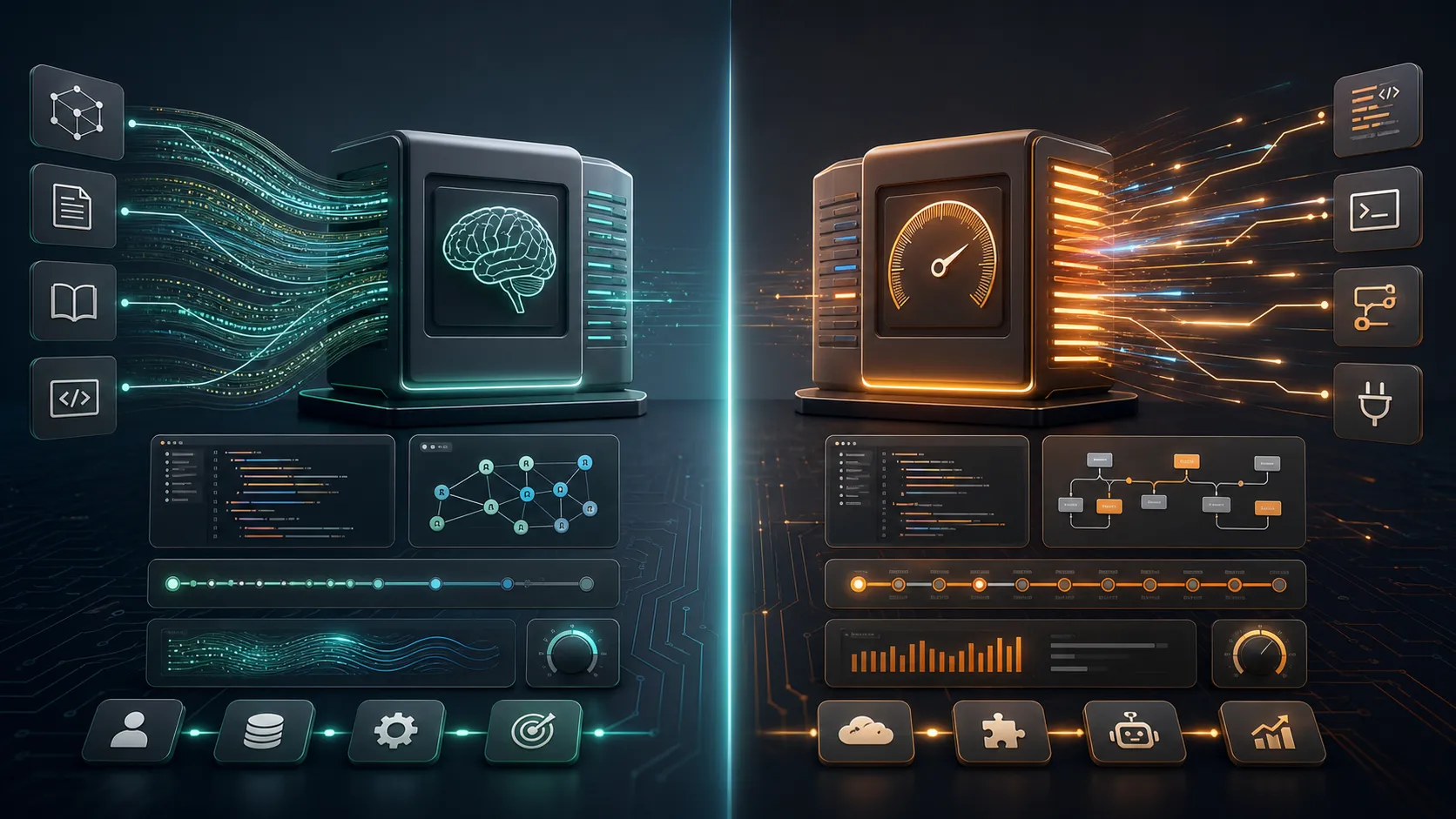
DeepSeek V4 is not just another AI model release. With V4 Pro, V4 Flash, a 1M-token context window, API access, open weights, and stronger support for AI agents, DeepSeek is becoming a serious option for developers and businesses that want powerful AI without relying only on OpenAI, Claude, or Gemini.
The practical question is not simply “what is DeepSeek V4?” The better question is whether a business should use V4 Flash or V4 Pro for coding, automation, customer support, document analysis, and agentic workflows.
Search behavior around DeepSeek V4 has also shifted from general curiosity to implementation intent. The draft research behind this guide notes rising demand for “deepseek v4 pro,” “deepseek v4 api,” “deepseek v4 flash,” technical reports, pricing, benchmark comparisons, and integrations with tools such as OpenClaw and Claude Code. That kind of demand matters because it shows that buyers and developers are evaluating DeepSeek as production infrastructure, not only as a model announcement.
This guide explains how DeepSeek V4 Pro and V4 Flash compare, where each model fits, how the API migration affects developers, and how businesses should think about AI agents, coding workflows, long-context analysis, and automation strategy.
What is DeepSeek V4?
DeepSeek V4 is described as a next-generation large language model family released in preview on April 24, 2026. The model family is built around a Mixture-of-Experts architecture, Multi-Token Prediction strategies, and long-context attention improvements designed to reduce the compute burden of processing very large prompts.
The product line is split into two main variants:
| Model | Primary focus | Best for |
|---|---|---|
| DeepSeek V4 Flash | Speed and cost efficiency | Faster, cheaper, everyday AI tasks, business automation, and simple agents |
| DeepSeek V4 Pro | Maximum intelligence | Hard reasoning, coding, complex agents, technical analysis, and long workflows |
V4 Pro targets top-tier knowledge, coding, reasoning, and agentic capabilities. V4 Flash is the economical, high-throughput alternative. V4 Flash can be a strong default when the workflow needs speed, scale, and predictable costs, while V4 Pro should be used when deeper reasoning quality matters more than latency or unit cost.

DeepSeek V4 Pro vs DeepSeek V4 Flash
The decision to use DeepSeek V4 Pro or DeepSeek V4 Flash affects technical quality, latency, throughput, and unit economics. Both models share the same broad architectural family, but their parameter scale and deployment targets are different.
| Feature | DeepSeek V4 Flash | DeepSeek V4 Pro |
|---|---|---|
| Total parameters | 284 billion | 1.6 trillion |
| Active parameters | 13 billion per token | 49 billion per token |
| Context length | 1,000,000 tokens | 1,000,000 tokens |
| Maximum output | 384,000 tokens | 384,000 tokens |
| Best use case | Cost-efficient production apps | Advanced reasoning and agents |
| Pricing style | Extremely economical | Premium, stronger output |
| Ideal user | Startups, SaaS apps, automations | Developers and complex workflows |
Mixture-of-Experts architecture
DeepSeek V4 Pro is described as a 1.6-trillion-parameter model, which gives it a very large pool of learned capability. Running all parameters for every generated token would be impractical, so the Mixture-of-Experts routing network activates only the most relevant expert subnetworks for each token. In the draft specification, V4 Pro activates 49 billion parameters per token.
V4 Flash uses the same general principle at a smaller scale. It is described as a 284-billion-parameter model with 13 billion active parameters per token. That selective activation is the reason DeepSeek can target strong model quality while keeping inference costs lower than a dense model of similar total size.
Attention and memory efficiency
The central technical differentiator in the draft is the 1,000,000-token context window. Traditional attention mechanisms become expensive as the prompt gets longer because memory and compute requirements rise sharply. DeepSeek V4 is described as using Compressed Sparse Attention and Heavily Compressed Attention to reduce the cost of processing long context.
Compressed Sparse Attention compresses historical Key-Value caches and selects relevant compressed blocks. Heavily Compressed Attention compresses tokens across larger intervals. Together, those mechanisms are presented as the foundation for million-token processing with lower memory pressure.
Signal stability for long workflows
For AI agents, stability matters. A model can be impressive in a short benchmark and still fail when it needs to preserve intent across a long tool-use session. DeepSeek V4 introduces Manifold-Constrained Hyper-Connections in the draft research, replacing traditional residual connections with a more constrained signal path.
The business interpretation is simple: long workflows need the model to preserve reasoning quality across many steps. If signal quality decays, an AI agent can drift, repeat itself, ignore constraints, or make lower-quality tool calls.
Why the 1M-token context window matters
A 1,000,000-token context window changes how teams think about business data. Historically, processing large enterprise information required chunking, embeddings, vector databases, and careful retrieval design. Retrieval-Augmented Generation still matters, but a million-token model allows teams to place much larger inputs directly into active model context.
One million tokens is often described as roughly 1,500 pages of dense text. That opens practical use cases:
- Full codebases: engineering teams can give the model enough context to understand cross-file dependencies, security issues, and architecture-level refactors.
- Long PDFs and documentation: analysts can process large reports, filings, policies, legal documents, or technical manuals in fewer passes.
- CRM exports: sales and marketing teams can analyze customer transcripts, call notes, support tickets, and pipeline history together.
- Customer support history: agents can review a customer’s multi-year interaction history before generating a response.
- SEO audits: teams can analyze sitemaps, server logs, Google Search Console exports, keyword data, and competitor research together.
- Internal business processes: operations teams can turn standard operating procedures into a large, queryable knowledge layer.
- Compliance and policy review: teams can compare large policy sets against proposed internal documents.

This capacity directly supports LLM integration, Model Context Protocol integration, and AI workflow automation. It also creates a practical advantage for businesses that want AI systems to reason over complete operational context instead of isolated snippets.
DeepSeek V4 API implementation notes
Migrating to the DeepSeek V4 API is presented as a low-friction migration for teams already using OpenAI-style or Anthropic-style interfaces.
The draft sources list these base URLs:
- OpenAI-compatible base URL:
https://api.deepseek.com - Anthropic-compatible base URL:
https://api.deepseek.com/anthropic
The model IDs described in the draft are:
deepseek-v4-flashdeepseek-v4-pro
The key migration detail is that older aliases such as deepseek-chat and deepseek-reasoner are described as deprecated, with a July 24, 2026 discontinuation date. In the transition model described by the draft sources, deepseek-chat maps to non-thinking V4 Flash and deepseek-reasoner maps to thinking-mode V4 Flash.
Teams should update to explicit V4 model IDs rather than relying on aliases. That reduces future outage risk and makes it easier to route different workloads to Flash or Pro intentionally.
Pricing: why Flash may be the practical default
The pricing model in the article draft is built around one million token units, with different rates for cache misses, cache hits, and output generation.
| Model | 1M input tokens, cache miss | 1M input tokens, cache hit | 1M output tokens |
|---|---|---|---|
| DeepSeek V4 Flash | $0.14 | $0.0028 | $0.28 |
| DeepSeek V4 Pro | $1.74 | $0.0145 | $3.48 |
| Claude Opus 4.7 | $5.00 | N/A | $25.00 |
| OpenAI GPT-5.4 | $2.50 | N/A | $15.00 |
The draft also notes a 75% promotional discount for DeepSeek V4 Pro through May 31, 2026, which would lower the effective cache-miss input rate and output rate during the promotion. For long-term planning, businesses should model standard pricing, not only promotional pricing.

Prefix cache economics
The most important cost lever is caching. In the draft pricing, a DeepSeek V4 Flash cache hit drops input cost from $0.14 to $0.0028 per million tokens. That changes architecture.
Teams are encouraged to use stable, reusable prefixes where appropriate. Examples include policy documents, codebase summaries, product documentation, brand rules, compliance instructions, or workflow-specific operating procedures. If repeated requests can hit the same cached prefix, the cost per task can fall sharply.
For most business automation, V4 Flash should be the first model tested. It is a better economic fit for customer support, content pipelines, internal Q&A, classification, routing, extraction, lead qualification, and simple agent steps. V4 Pro should be reserved for complex reasoning, software engineering, long-horizon planning, and high-risk decisions.
DeepSeek V4 for AI agents and coding tools
AI development is moving toward agentic workflows, where the model can read files, call tools, inspect output, revise plans, and produce code changes. DeepSeek V4 is being evaluated in that context because it combines long context, tool-use support, JSON output adherence, and pricing that could make long coding sessions cheaper.
Integrating with Model Context Protocol
The Model Context Protocol is becoming a standard way to connect AI models to external tools, local files, databases, and enterprise APIs. Instead of building a different integration for every model and service, MCP provides a common protocol for exposing tools to AI clients.
In an enterprise workflow, a DeepSeek-backed MCP setup could let an assistant inspect internal documentation, query business systems, or draft changes while staying inside a controlled tool boundary. That matters because most production AI systems need permissions, logging, approval gates, and rollback paths.
For example, the draft includes this style of CLI configuration for connecting a DeepSeek MCP server to Claude Code:
export DEEPSEEK_MCP_AUTH_TOKEN="YOUR_TOKEN"
claude mcp add --transport http deepseek https://deepseek-mcp.yourdomain.com/mcp --header "Authorization: Bearer $DEEPSEEK_MCP_AUTH_TOKEN"
The exact implementation should be adapted to the organization, security model, hosting environment, and MCP client.
Can DeepSeek V4 replace Claude Code or OpenAI for coding agents?
DeepSeek V4 Pro is presented as a strong option for coding agents. The draft cites SWE-bench Verified performance near Claude Opus 4.6, a 1M context window, tool support, and lower output costs than premium proprietary alternatives.
That does not mean teams should blindly replace an existing model. Coding-agent quality depends on more than the model:
- Tool calling accuracy.
- Repository access and sandbox permissions.
- Prompt and context management.
- Retry behavior.
- Diff quality.
- Test execution.
- Human approval for risky changes.
- Logging and rollback.
The right process is to benchmark DeepSeek V4 Pro against Claude, OpenAI, Gemini, Qwen, Kimi, and any current internal default on real tickets from the organization’s own codebase. Public benchmarks are useful, but production agent quality is workflow-specific.
Business use cases for DeepSeek V4
The best model depends on the business process. A support chatbot, a lead qualification workflow, and a coding agent do not need the same reasoning budget.
| Use case | Better model | Strategic rationale |
|---|---|---|
| AI customer support chatbot | V4 Flash | Low latency and high concurrency matter more than deep reasoning |
| Lead qualification automation | V4 Flash | Structured extraction and routing should be fast and inexpensive |
| Long document Q&A | V4 Flash or Pro | Flash is enough for simple summarization, while Pro fits complex contradictions |
| SEO audit assistant | V4 Flash | Large-context synthesis often matters more than complex math |
| Codebase analysis | V4 Pro | Architecture-level refactors require stronger reasoning |
| AI coding agent | V4 Pro | Autonomous ticket resolution needs persistent reasoning and precise tool use |
| Internal knowledge base chatbot | V4 Flash | Retrieval and summarization benefit from speed and low cost |
| Complex multi-step business agent | V4 Pro | Supply-chain, finance, or vendor workflows need stronger logical depth |
For teams building practical AI agent development systems, the route is usually simple: use Flash for common steps, escalate to Pro only when the workflow needs deeper reasoning, and log the cost and outcome of each completed task.
Risks, guardrails, and things to watch
DeepSeek V4 can be useful, but production adoption needs practical guardrails.
Preview status and stability matter. The draft describes V4 Flash and V4 Pro as preview models, which means endpoints, weights, latency, routing, and output behavior may change. Production systems should include fallback logic, retries, and monitoring.
Independent benchmarks matter. Vendor reports and technical writeups are useful, but each business should test the model on its own tasks. This is especially true for coding agents, compliance analysis, legal review, and high-stakes business workflows.
Pricing volatility matters. Promotional pricing can make a model look better than the long-term cost structure. Model ROI should be calculated from standard rates, cache behavior, output length, retries, and total cost per completed task.
Data privacy matters. Any public API can require sending proprietary data to a third-party system. Regulated teams should review data residency, retention, security, vendor terms, and whether self-hosting is required.
Agentic guardrails matter. Tool-using AI agents should run with limited permissions, human approval for state-changing actions, cost caps, logs, and clear rollback paths. Read-only should be the default until the workflow is proven.
Hardware and geopolitical context matter. The draft describes DeepSeek V4 as adapted for Huawei Ascend AI chips during a period of US export controls and changing semiconductor supply chains. Businesses should avoid assuming that model availability, pricing, and cloud capacity will remain static.
When to use Build, Automate, and Grow
DeepSeek V4 is most useful when it is part of a real business system, not a standalone model test.
- Build: Use DeepSeek V4 when a custom SaaS MVP, dashboard, internal tool, or web application needs AI-assisted analysis, code workflows, or large-context reasoning.
- Automate: Use V4 Flash or V4 Pro when repetitive work involves customer support, document processing, lead routing, data extraction, or tool-using AI agents.
- Grow: Use AI analysis to support SEO, GEO, content systems, campaign analysis, and conversion strategy, then connect those insights to measurable business outcomes.
For businesses in Florida or across the United States, the best result usually comes from matching the model to the workflow. DeepSeek V4 Flash can be the default engine for routine automation. DeepSeek V4 Pro can be the escalation path for complex reasoning, coding, and agentic planning.
If you want to map DeepSeek V4 into a real production workflow, start with the business process first: what data enters, what decision is made, what system changes, who approves it, what it costs, and how success is measured. Then choose the model.
Conclusion
DeepSeek V4 Pro and V4 Flash change the AI model conversation because they combine large context, open-weight positioning, API compatibility, agent support, and aggressive pricing. V4 Flash is the practical default for most business automation. V4 Pro is the stronger fit for hard reasoning, coding agents, long-horizon workflows, and technical analysis.
The strongest implementation pattern is not “use the smartest model for everything.” It is model routing: use Flash by default, escalate to Pro when the work justifies it, and measure the result per completed task.
To explore how this fits into a production workflow, schedule a consultation.
Works Cited
- DeepSeek V4 technical report
- DeepSeek V4 (2026): Specs, Benchmarks, API Pricing, and More
- DeepSeek V4 API Review 2026: Flash vs Pro Guide
- DeepSeek V4 Pricing & API Migration (2026)
- DeepSeek V4 Pro vs Kimi K2.6 model comparison
- Models & Pricing | DeepSeek API Docs
- DeepSeek Pricing & API Costs: Complete Guide (2026)
- How to Run Claude Code Against DeepSeek V4
- Awesome DeepSeek Agent
- The Model Context Protocol (MCP) - A Complete Tutorial
- deepseek-mcp-server
- DeepSeek MCP server listing
- LLM Coding Benchmark: DeepSeek, Kimi, Grok, GPT
- Integrate with OpenClaw | DeepSeek API Docs
- DeepSeek | OpenClaw Docs
- DeepSeek launches V4 model adapted for Huawei AI chips
- Huawei Ascend 950 chip demand surges after DeepSeek V4 launch
- Chinese tech firms rush for Huawei AI chips after DeepSeek V4 launch