
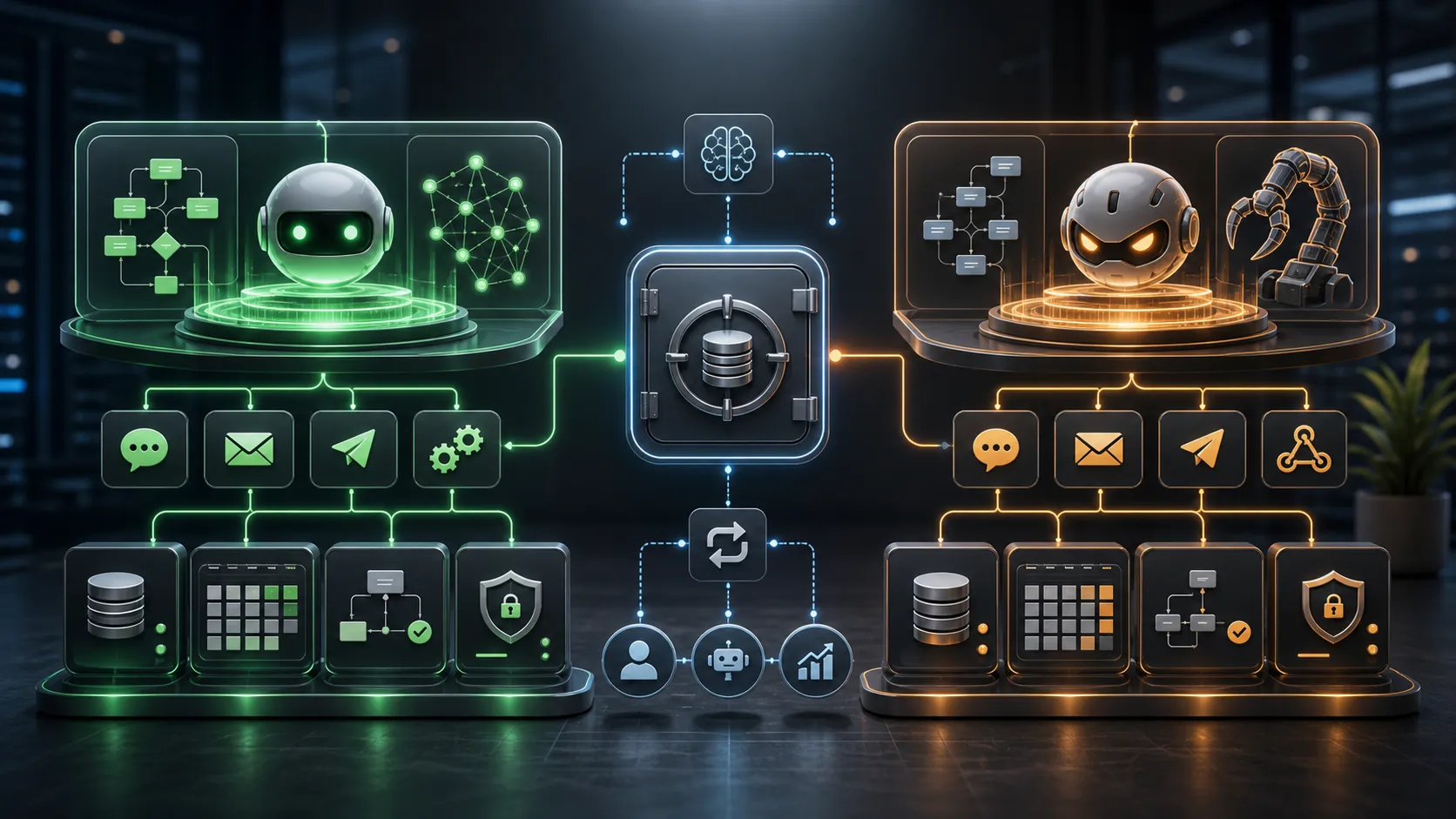
The enterprise AI landscape is shifting from short-lived chat sessions toward persistent, self-hosted agents that can remember work, execute tools, and run in the background. For several years, many teams relied on transient chat interfaces where project history, procedural knowledge, and local context disappeared when the session ended. That pattern is useful for one-off answers, but it is weak for recurring workflows, complex technical environments, and private business automation.
Hermes Agent and OpenClaw sit near the center of this shift. Both are positioned around self-hosted, always-available AI infrastructure, but they are not trying to solve the same problem. Hermes Agent is built around persistent memory, autonomous execution, and skill creation. OpenClaw is built around a mature multi-channel assistant gateway that connects AI behavior to messaging platforms and collaboration tools.
For organizations evaluating always-on AI infrastructure, the right question is not simply “which tool is better?” The better question is: do you need a self-improving execution agent, or do you need a reliable AI gateway across chat channels?
What is Hermes Agent?
Hermes Agent is an open-source autonomous AI agent associated with Nous Research, the organization behind the Hermes, Nomos, and Psyche model families. The draft source describes it as a persistent orchestration layer that runs on local servers or physical infrastructure rather than acting only as a thin graphical wrapper around cloud LLM providers.
The core promise is local control. Hermes Agent is designed to support local runtimes such as LM Studio, Ollama, and local vLLM, while also supporting cloud endpoints through the Nous Portal or OpenAI-compatible APIs. That flexibility matters for businesses that want to choose between offline execution, private infrastructure, and cloud model access depending on risk, cost, and workload.
The most important architectural idea is the continuous learning loop. Instead of requiring a user to restate the same context, deployment process, preferences, and coding conventions in every session, Hermes Agent is designed to turn successful work into persistent memory and reusable skills.
The five-stage continuous learning architecture
The draft describes Hermes Agent as operating through a five-stage learning loop:
- Capture working context: The agent observes commands, APIs, files, and decisions while completing a task.
- Build persistent facts: Stable knowledge such as project conventions, deployment targets, and recurring preferences is saved into local memory files.
- Distill procedural skills: Successful workflows are turned into reusable
SKILL.mddocuments so the agent can repeat the procedure later. - Scan before saving: New memories and skills are checked against existing context to reduce contradictions and token bloat.
- Recall across sessions: Future sessions can query historical memory and skills instead of starting from zero.
That design makes Hermes Agent most interesting for developers, founders, consultants, and teams that repeatedly work inside the same technical environment.
Multi-platform gateways and hardware optimization
Hermes Agent is not limited to a local terminal workflow. The draft positions it as a gateway process that can connect to platforms such as Telegram, Discord, Slack, WhatsApp, Signal, and the local CLI. In practical terms, a user could start a codebase audit or research workflow from a messaging app while the agent executes the heavy work on the host machine.
Because the agent is designed for continuous operation, it can benefit from dedicated hardware. The draft references NVIDIA positioning systems such as DGX Spark and Tensor Core GPUs as strong environments for running larger local models like Qwen 3.6. The business value is not only faster chat responses; it is faster multi-step execution, skill refinement, and background automation.
Why is Hermes Agent trending?
The draft identifies fast-rising search interest around Hermes Agent and self-hosted AI agent infrastructure. The trend signals are useful because they show a move from general AI curiosity toward implementation intent.
| Search query | Trend signal | Market implication |
|---|---|---|
| “hermes agent” | +4,700% increase | A large influx of users and organizations are discovering self-hosted agent options. |
| “hermes agent github” | Breakout status | Developers are looking for source code, installation scripts, and deployment details. |
| “hermes agent vs openclaw” | Breakout status | Buyers and builders want architectural comparisons, not just definitions. |
| “hermes ai” | +250% increase | Broader AI-curious users are exploring self-hosted alternatives for business automation. |
The underlying driver is clear: teams want more autonomy, better memory, lower vendor lock-in, and stronger data sovereignty. A persistent agent that learns from previous work can reduce repeated prompting and make local infrastructure more useful over time.
The breakout interest in “Hermes Agent GitHub” also matters. It suggests that many users are not waiting for a polished SaaS landing page. They want to inspect the repository, evaluate the MIT-licensed software, review the memory loop, and decide whether the tool is production-ready for their own environment.
Hermes Agent vs OpenClaw
Hermes Agent and OpenClaw both belong to the self-hosted AI infrastructure conversation, but their operating philosophies are different.
OpenClaw is described as a mature open-source AI assistant gateway developed across many GitHub repositories. Its core strength is routing an AI assistant across messaging and collaboration platforms. The draft lists support for Discord, Google Chat, iMessage, Matrix, Microsoft Teams, Signal, Slack, Telegram, WhatsApp, and Zalo through a unified process.
Hermes Agent is more execution-centered. It is designed for memory, skill creation, scheduling, sub-agents, and long-running automation. OpenClaw is more gateway-centered. It is designed for reliable message handling, session routing, and assistant availability across communication channels.
| Evaluation dimension | Hermes Agent architecture | OpenClaw architecture |
|---|---|---|
| Core operational idea | A self-improving autonomous agent centered on persistent memory and dynamic skill creation. | A multi-channel gateway designed to route AI assistants across messaging applications. |
| Ideal target audience | Developers, technical founders, and automation consultants who need execution that learns over time. | Operational teams and organizations that need an assistant embedded in existing chat apps. |
| Primary search intent | “Hermes Agent GitHub”, “Hermes AI”, “persistent memory AI agent”, and “self-hosted AI agent”. | “OpenClaw docs”, “install OpenClaw”, “OpenClaw security”, and “OpenClaw multi-agent routing”. |
| Memory and learning loop | Built around persistent memory and reusable SKILL.md generation from successful work. |
Uses session-based memory management, daily markdown logs, and manual workspace bootstrap files. |
| Automation and scheduling | Native scheduling for unattended recurring background tasks. | Usually depends on external triggers or workflow software for scheduled automation. |
| Sub-agent architecture | Spawns isolated sub-agents for parallel workstreams. | Uses delegate routing for specialist assistant lanes. |
| Execution philosophy | Active orchestration for long-running code execution, research, and local hardware acceleration. | Reliable message lifecycle management, chunking, drafts, and steering queues for chat interactions. |

Choosing between these tools is really a question about what “agentic AI” means inside the organization. If the priority is deep technical execution, context retention, and reusable workflow learning, Hermes Agent is the stronger conceptual fit. If the priority is unified AI availability across communication channels, OpenClaw is the more natural fit.
Practical advice and examples
Self-hosted agents are strongest when the workflow is too dynamic for a static script but too repetitive to keep doing manually. The following examples show where Hermes-style execution and gateway-style assistant access can create practical business value.
Example 1: Autonomous code deployment pipeline
A developer can instruct Hermes Agent to manage the lifecycle of a commit: “Deploy the latest commit from origin/main to staging, then promote to production once staging is verified.”
The agent can interpret that as a multi-step pipeline:
- Pull the branch and inspect the commit diff for security flags.
- Run the local test suite inside a controlled terminal.
- Build the Docker image and deploy it to staging.
- Tail the health check endpoint until it returns HTTP 200.
- Monitor the endpoint for a stabilization period before promoting to production.
If the health check fails, the agent can use memory to look for similar past failures, attempt a known fix from a saved skill, and alert the developer when human review is required.
Example 2: B2B sales and CRM automation
The draft describes a business automation pattern where Hermes Agent is combined with community-developed sales skills, MCP integrations, and third-party APIs. The agent can scan target domains, qualify leads, update records in a Supabase CRM, and draft personalized outreach across email or WhatsApp.
Because the agent supports scheduling, the workflow can run unattended before the workday begins. The sales team receives fresher records, better qualification notes, and draft outreach without manually assembling the same research every morning.

Example 3: Multi-stage content and research generation
Marketing teams can use sub-agent architecture to split research and drafting work into specialized lanes:
- Researcher: Browses competitor websites, extracts pricing, and gathers examples.
- Synthesizer: Filters raw findings into a structured markdown brief.
- Drafter: Produces a report using the tone and formatting rules stored in memory.
- Reviewer: Checks the draft against SEO, compliance, and quality constraints before publication.
This does not remove the need for human strategy or review. It does reduce the manual assembly work that slows down content, research, sales enablement, and competitive analysis.
Who should use Hermes Agent?
Hermes Agent is best suited for environments where repeated technical execution, memory, and local control matter.
Developers seeking an AI coding and workflow assistant
Developers working on long-lived projects often lose time re-explaining repository structure, deployment rules, code conventions, and previous decisions to generic AI tools. Hermes Agent is designed to retain that context across sessions, which can make recurring tasks such as log analysis, release preparation, Docker troubleshooting, and codebase audits more efficient.
Founders requiring scheduled automation and recurring reports
Founders often manage scattered data across calendars, GitHub, Linear, financial dashboards, CRM systems, and Slack channels. A persistent agent with scheduling can assemble a morning briefing, summarize blockers, check project movement, and deliver updates through a preferred communication channel.
AI automation consultants building private client workflows
Consultants need secure, customizable infrastructure that can be deployed inside client environments. Hermes Agent is useful where workflows must stay private, connect to legacy systems, or use reusable skills that encode client-specific procedures.
This is also where AI agent development, MCP integration, LLM integration, and AI workflow automation become implementation work rather than abstract tooling choices.
Power users demanding always-on terminal and messaging access
Power users benefit from the ability to start a task in the terminal, leave the desk, and continue steering it from Telegram or Discord. The value is not only mobility. It is continuity across long-running work.
Teams experimenting with memory, skills, MCP, and browser automation
Teams exploring advanced agentic systems need a sandbox where the agent can access approved tools, navigate legacy portals, use browser automation, and remember the environment. Hermes Agent is a fit when that experimentation requires local control rather than a closed SaaS workflow.
Security and privacy considerations
Self-hosted agents introduce a different security model from normal chatbots. When an agent can execute commands, modify files, read calendars, use APIs, and interact with messaging systems, the attack surface grows.
The inbound messaging vulnerability in OpenClaw
OpenClaw’s strength is also its risk surface. Because it bridges AI capabilities with platforms such as WhatsApp, Telegram, and Discord, inbound direct messages must be treated as untrusted input.
The main risk is prompt injection. Malicious instructions can be hidden inside a website, message, document, or chat thread. If the assistant has broad tool access, those instructions may try to steer it into bypassing policy, exposing workspace data, or taking an unauthorized action.
For any public-facing messaging deployment, administrators should use strict allowlists, pairing behavior, owner review, validation checks, and sandboxing. Default convenience settings should not be treated as production security.
Sandboxing and workspace hardening
Both Hermes Agent and OpenClaw rely on files to store workspace context, memory, and configuration. That makes workspace boundaries important.
OpenClaw’s agent workspace is the default current working directory for agent work, but the draft warns that it is not automatically a hard sandbox. If absolute paths remain available, an agent may still reach beyond the intended workspace unless sandboxing is explicitly configured.
The same general rule applies to all self-hosted agents: do not place raw secrets in agent memory. API keys, OAuth tokens, passwords, and client credentials should not be stored in AGENTS.md, MEMORY.md, USER.md, or general workspace notes. Use environment variables, credential stores, and tightly scoped service accounts instead.
Hermes Agent attempts to reduce execution risk through local execution, no telemetry claims, and container hardening. The draft describes isolated containers, read-only root file systems, dropped Linux capabilities, PID limits, and guidance against running the gateway as root. Those details are important, but they do not replace disciplined access control.
Common mistakes and deployment considerations
Deploying self-hosted agent infrastructure is more like deploying software than installing a productivity app. Teams should expect environment, networking, dependency, and governance work.
| Failure category | Common symptom | Root cause and resolution |
|---|---|---|
| Operating system incompatibility | Native Windows is not supported during install. | Hermes Agent depends on POSIX tooling; Windows users should use WSL2 or Linux. |
| Path environment failures | hermes: command not found after installation. |
The executable path is not loaded; refresh the shell profile or update PATH. |
| Network and installation blocking | GitHub clone fails with 403 or timeouts. | Corporate firewalls or ISP restrictions may block the default clone path. |
| API key and provider configuration | Model selection fails or returns HTTP 429. | Provider prefixes, API keys, and account credits must be configured correctly. |
| Context exhaustion and memory drift | The agent loses directives or retrieves low-value memory. | Memory compression, context limits, and summary policies need tuning. |
| Parallel execution stalling | A multi-agent board stops progressing. | Dependencies between sub-agents are unclear or state isolation is weak. |
The operational lesson is simple: start with a contained workflow, prove the control path, then expand tool permissions and scheduling.
When to contact a professional
Moving from experimental AI scripts to production-grade agentic workflows requires architecture, security, and integration work. A curl installation script is not the whole implementation.
Teams need to decide how the agent will access tools, where memory will live, which actions require approval, how logs will be reviewed, how secrets will be stored, and how failures will be rolled back. They also need to connect the agent to real business systems such as CRMs, ERPs, support inboxes, analytics platforms, and content pipelines.
For businesses in Hialeah, Miami, Fort Lauderdale, Orlando, Florida, and remote teams across the United States, the best use of a technical partner is turning agentic tooling into measurable workflows. That may include private agent hosting, MCP server design, CRM automation, lead routing, AI reporting, and SEO content systems.
Automating a broken process only makes the broken process faster. The stronger path is to map the business process first, then decide which parts should be deterministic workflows, which parts should use AI judgment, and which parts require human approval. To plan that kind of implementation, schedule a discovery call.
Is Hermes Agent better than OpenClaw?
Hermes Agent is the better fit when the main objective is deep technical execution, memory retention, reusable skill creation, scheduling, and self-improving workflow automation. Its value is highest for developers, consultants, and technical teams building multi-step systems.
OpenClaw is the better fit when the main objective is a mature multi-channel assistant gateway. If the organization wants AI assistance inside Microsoft Teams, Slack, iMessage, Signal, Telegram, or WhatsApp, OpenClaw’s routing and message lifecycle model is the clearer match.
The practical answer is that the tools can solve different layers of the same business architecture. Hermes Agent is closer to an execution worker. OpenClaw is closer to a communication gateway.
Conclusion
The era of purely ephemeral AI wrappers is starting to give way to persistent, self-hosted, agentic infrastructure. Hermes Agent and OpenClaw both reflect that shift, but they point in different directions.
Hermes Agent is about memory, execution, skills, scheduling, and local control. OpenClaw is about messaging, assistant routing, and multi-channel availability. The best choice depends on whether the organization needs an agent that does work over time or a gateway that reliably connects AI to communication channels.
For technical teams and business operators ready to move from manual workflows to controlled agentic automation, the next step is not chasing every new framework. It is designing the workflow, permissions, memory boundaries, review process, and measurable business outcome before the agent is allowed to act.
Works Cited
- NousResearch/hermes-agent: The agent that grows with you
- Hermes Agent Explained: Memory, Skills, and Enterprise Fit
- Hermes Agent - Open-Source AI Agent with Persistent Memory
- Hermes Unlocks Self-Improving AI Agents, Powered by NVIDIA RTX PCs and DGX Spark
- Agent workspace - OpenClaw Docs
- Hermes Agent Troubleshooting Guide
- Hermes Agent vs Claude Code: Which Should You Use for Agentic Work?
- OpenClaw - GitHub
- OpenClaw Docs
- Hermes Agent use cases: 10 examples of what you can do
- MEGATHREAD: Hermes Agent Use Cases - What the Community is Building
- Installation | Hermes Agent
- What OpenClaw reveals about agentic AI security risks
- [Bug]: dmPolicy allowlist not blocking AI from responding to inbound WhatsApp DMs #80538
- Security warning issued over OpenClaw AI agent
- Hermes API Integration: A Complete Setup Guide and How It Works
- My frustrating experience with Hermes
- OpenClaw Errors: Common Issues & How to Fix Them