
Introduction: The Operational Imperative of Instantaneous Response
In the highly competitive and rapidly evolving landscape of local service businesses, spanning commercial HVAC installations, legal services, real estate brokerages, plumbing operations, and specialized contracting, the velocity of customer engagement dictates market share and long-term viability. The modern consumer operates with an intrinsic expectation of immediate gratification, fundamentally altering the economics of lead acquisition and the digital visibility paradigms required to capture demand. However, the internal infrastructure of most local businesses remains stubbornly anchored in legacy, manual processes that cannot scale to meet these instantaneous expectations.
As organizations invest heavily in localized search visibility, advertising, and digital growth, the failure to process generated leads at high speed results in catastrophic revenue leakage. The integration of Artificial Intelligence (AI) into lead response mechanisms has transitioned from an experimental luxury to a fundamental operational requirement. Automation systems now orchestrate complex, multi-layered workflows that capture, enrich, critically qualify, and respond to inbound inquiries within milliseconds, eliminating the friction that traditionally results in abandoned engagements. By utilizing advanced low-code frameworks such as n8n for workflow orchestration and the Model Context Protocol (MCP) for agentic, autonomous scheduling, service enterprises can bridge the gap between initial digital contact and closed revenue.
Furthermore, the deployment of these automated response systems transcends mere operational efficiency; it directly impacts digital visibility on search engine result pages. Fast, reliable engagement signals algorithmic trust to search engines, inextricably linking automated AI workflows with Generative Engine Optimization (GEO) and technical Search Engine Optimization (SEO). This comprehensive analysis details the underlying architecture, the rigorous compliance mandates, and the strategic implementation of AI lead response automation for local service businesses operating in dynamic markets, including Miami, Hialeah, Fort Lauderdale, Orlando, and the broader United States.
The 2026 Speed-to-Lead Crisis
The disparity between consumer expectations, executive beliefs, and actual business performance has never been more pronounced. Exhaustive data collected and analyzed through 2026 reveals a systemic failure in traditional sales operations, driven predominantly by an over-reliance on manual human intervention in environments that demand programmatic speed.
Defining the Performance Chasm
Speed-to-lead, defined as the duration between a prospect’s initial high-intent inquiry and the enterprise’s first targeted, meaningful response, remains the single strongest predictor of conversion in B2C and B2B sales. In 2026, the accepted gold standard benchmark dictates a response within five minutes; however, empirical reality falls drastically short of this idealized metric. A comprehensive study of 1,000 B2B and service companies utilizing specialized tracking parameters demonstrated that the average response time among entities that actually reply is an astonishing 1 day, 5 hours, and 17 minutes. More alarmingly, the data indicates that 63.5% of organizations never respond to inbound inquiries at all, representing a massive loss of invested marketing capital.
The financial consequences of this systemic delay are severe and immediate. Approximately 81.2% of companies that require over an hour to respond report losing leads directly to faster, more agile competitors. This dynamic illustrates a strict “conversion cliff” that occurs rapidly after the initial inquiry is submitted. Research repeatedly validates that responding within the first minute yields a 391% increase in conversion likelihood compared to delayed engagements. At the critical five-minute mark, organizations are 100 times more likely to successfully contact a lead and 21 times more likely to qualify them effectively than if they attempt contact at the 30-minute mark. Consequently, buyer behavior solidifies around the first mover: 78% of modern buyers finalize their purchase with the first company that initiates a response.
The AI vs. Manual Divide
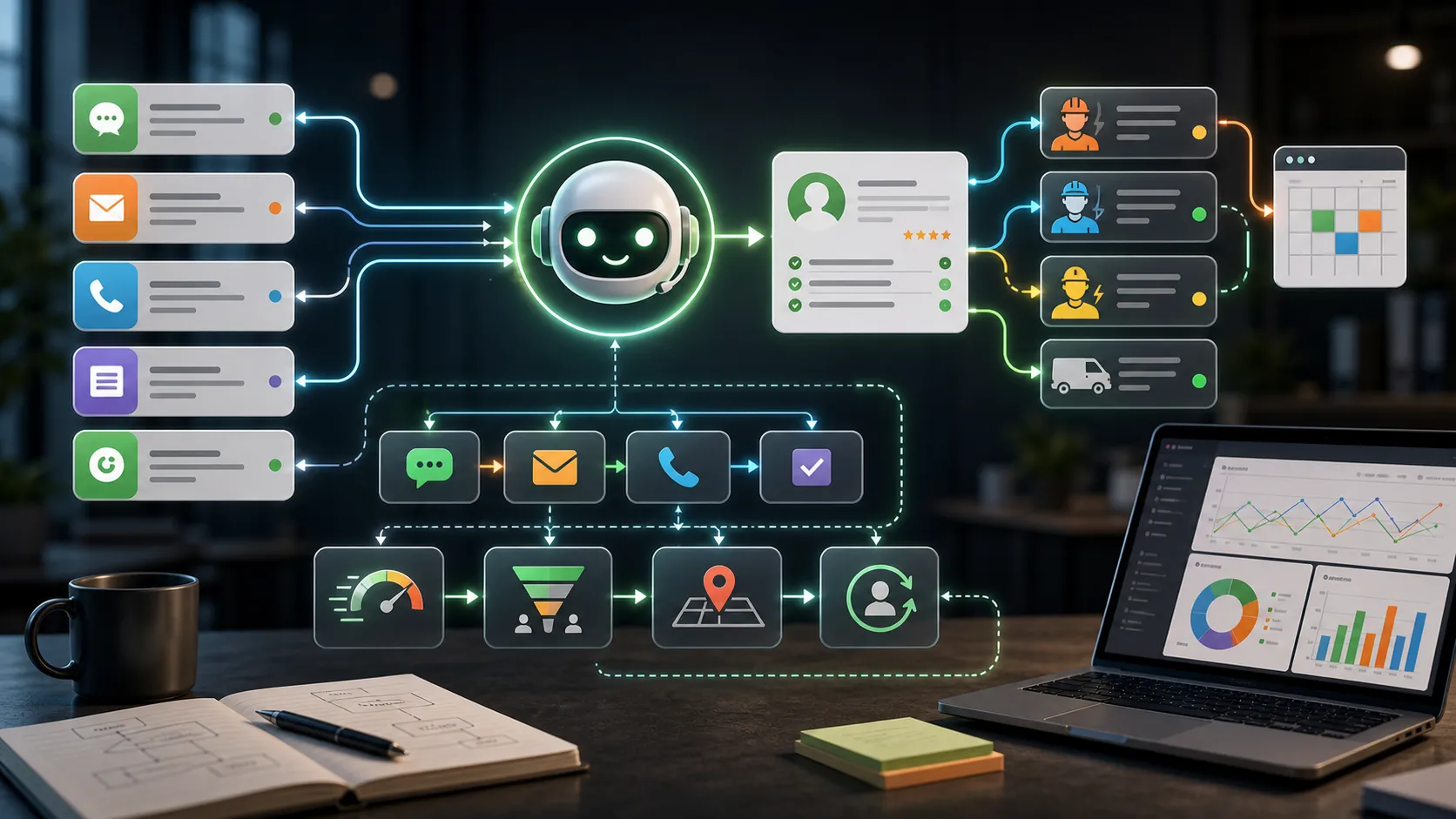
AI lead response workflow

The integration of advanced automation has created a distinct operational bifurcation in market performance. Teams relying exclusively on manual operations face insurmountable logistical hurdles that directly impair their competitive positioning. Sales development representatives, intake specialists, and dispatchers typically spend only 30% of their operational bandwidth on actual selling or engagement; the remaining 70% is consumed by administrative tasks, CRM updates, initial research, and internal communications. Conversely, companies utilizing AI automation exhibit dramatically superior performance metrics. Data from 2026 indicates that 62.5% of AI-enabled companies successfully meet the strict under-15-minute response standard, whereas a mere 39.1% of manual-only businesses achieve this benchmark. Furthermore, manual operators report a 69.1% lead leakage rate, which is approximately 15% higher than their AI-equipped counterparts.
The disparity extends deeply into after-hours operations. The contemporary consumer expects ubiquitous availability, with over 40% of high-intent web inquiries arriving during evenings and weekends. Manual teams typically exhibit an “after-hours blind spot,” going completely silent for 61 hours from Friday evening until Monday morning. AI systems provide continuous, uninterrupted coverage, effectively eliminating this temporal gap by ensuring that a lead submitted at midnight on a Saturday receives the same instantaneous, qualified response as a lead submitted during peak Tuesday hours.
Industry-Specific Vulnerabilities and Cost Implications
The operational cost of delayed responses is most acutely felt in sectors characterized by high customer acquisition costs and rising average Costs Per Lead (CPL). The table below outlines the 2026 speed-to-lead benchmarks and financial vulnerabilities across key local service verticals, demonstrating how systemic delays directly impact the profitability of these organizations.
| Industry sector | Average response reality | Target benchmark | Average cost per lead |
|---|---|---|---|
| Legal services | 13 minutes median | Under 5 minutes | $649 |
| HVAC and home services | 88% exceed 5 minutes | Under 1 minute | $92 |
| Real estate brokerage | 15 hours | Under 5 minutes | $448 |
| Insurance providers | Varies, highly volatile | Under 1 minute | $424 |
| Solar installation | 15-30 minutes | Under 1 minute | $206 |
| Automotive dealerships | Varies widely | Under 5 minutes | $283 |
In the highly competitive legal and insurance sectors, consumer leads are frequently distributed to multiple providers simultaneously; the first organization to engage virtually guarantees the acquisition. At a staggering $649 blended CPL in legal services, a single abandoned lead represents a substantial financial loss, underscoring the absolute necessity for instantaneous, automated engagement protocols.
The Anatomy of Delay: Why Manual Systems Fail in 2026
Understanding the necessity of AI automation requires a deep examination of why manual systems universally fail to scale. The failure is rarely due to a lack of intent from sales personnel; rather, it is a structural failure of information routing, data entry friction, and human bandwidth limitations. The correlation between the friction of data collection and response latency is striking. Research evaluating lead capture mechanisms demonstrates that forms with one to two fields result in an average response time of 3 hours and 14 minutes, whereas forms demanding greater than nine fields push average response times beyond 1 day and 4 hours.
This occurs because complex manual intakes require human operators to manually verify, research, and cross-reference extensive data points before initiating contact. Furthermore, human teams are plagued by poor data hygiene resulting from typographical errors, incomplete data fields during manual entry, and incorrect synchronization between disparate CRM systems and marketing tools. When a dispatcher in Miami attempts to manually verify a prospect’s address while simultaneously managing incoming calls, the resulting delay guarantees that the high-intent prospect will begin searching for alternative providers. The modern solution shifts this entire burden from human cognitive load to deterministic, high-speed algorithmic execution.
System Architecture: Engineering the AI Lead Response Workflow
Transitioning an enterprise from a manual response paradigm to a highly automated, intelligent engine requires rigorous architectural planning and execution. Instead of relying on isolated, fragmented SaaS applications that do not communicate effectively, modern operations utilize advanced node-based orchestrators like n8n to build cohesive, self-hosted data pipelines. The n8n platform operates as a fair-code workflow automation tool that connects disparate applications, APIs, and databases through a visual interface. Because it can be self-hosted, it provides organizations with absolute sovereignty over their prospect data, a critical requirement for businesses operating under strict compliance frameworks. Establishing a robust automation sequence involves four highly integrated technical phases.
Phase 1: Real-Time Lead Capture and Ingestion
The automated sequence must initiate the exact millisecond a prospect submits an inquiry. Whether the point of origin is a localized landing page built for the Florida market on Webflow, a custom React application for SaaS MVPs, an inbound Google Local Services Ad, or an integrated Typeform questionnaire, the system relies on webhooks to capture the data payload instantaneously. Within the n8n environment, a designated Webhook Trigger Node actively listens for incoming HTTP POST requests. Unlike legacy batch-processing systems that execute cron jobs to check for new leads every fifteen minutes, webhooks ensure synchronous, immediate execution. The ingested payload typically contains primary identifiers including the prospect’s full name, email address, direct dialing number, and unstructured natural language text detailing their immediate service requirements.
Phase 2: Programmatic Data Enrichment
Raw contact data is inherently insufficient for intelligent AI qualification. Before the Large Language Model evaluates the prospect’s viability, the workflow must algorithmically append contextual firmographic, demographic, and geographic data to the profile. To accomplish this, the n8n orchestrator fires parallel HTTP Request nodes directed at third-party enrichment APIs such as Clearbit, Apollo.io, or Hunter.io. By passing the captured email domain or phone number as a query parameter, the system instantly retrieves vast arrays of supplemental information. For B2B service organizations, this includes the target company’s employee headcount, annual revenue range, and the specific job title and seniority level of the inquiring contact. For local B2C service businesses, enrichment might involve validating geographic markers to ensure the lead falls precisely within the established serviceable territory. This entire enrichment phase executes autonomously in the background within one to two seconds, transforming a sparse web form submission into a comprehensive, actionable prospect profile.
Phase 3: Intelligent AI Scoring and Cognitive Qualification
With a fully enriched dataset successfully aggregated in system memory, the workflow passes the structured information to an AI processing node, which is typically powered by advanced Large Language Models such as OpenAI’s GPT-4o or Anthropic’s Claude. This architectural stage represents a massive and foundational departure from traditional rules-based automation logic. Instead of relying on rigid, easily broken “IF/THEN” deterministic statements, the system utilizes advanced prompt engineering to mandate a cognitive evaluation of the data. The system prompt instructs the AI model to adopt the specific persona of a senior sales development representative deeply familiar with the organization’s Ideal Customer Profile (ICP). The LLM is provided with contextual boundaries regarding minimum budget thresholds, geographic service radii, and specific service offerings. The AI model processes the unstructured input and outputs a strict JSON object containing two critical key-value pairs:
- Qualification Score (1-10): A numerical representation of lead fit based on budget indicators, geographic location, and urgency.
- Reasoning Summary: A concise explanation of the algorithmic decision.
For example, the system might output: “Qualified (Score: 9): Prospect is located centrally in Hialeah, requires an immediate commercial roofing inspection, and matches the enterprise employee count profile.” When this node is properly configured with explicit prompt examples demonstrating both highly qualified and deeply unqualified leads, a technique known as few-shot prompting, AI qualification consistently achieves 85% to 90% accuracy in matching human executive judgment. Crucially, the AI executes this evaluation with consistency, entirely devoid of the fatigue or subjective bias that often degrades manual SDR performance.
Phase 4: Dynamic CRM Routing and Omnichannel Engagement
The final architectural phase involves actioning the AI’s cognitive decision. An automated Switch node within the n8n orchestrator parses the JSON output generated by the LLM.
If the lead is designated as “Unqualified”—perhaps because the request is strictly residential for a B2B firm, or the location is hundreds of miles outside the operational radius—the system automatically triggers a polite, contextually aware email declining the project. This maintains professional goodwill and preserves brand reputation without consuming valuable human operational bandwidth. Conversely, if the lead achieves a high qualification score, the system executes a simultaneous, multi-channel response protocol:
- CRM Synchronization: A native integration node pushes the enriched data, qualification score, and AI reasoning summary into the CRM, whether that is HubSpot, Salesforce, GoHighLevel, or another system. The workflow creates a populated deal record and assigns it to the correct owner.
- Human Alert Notification: An automated alert is dispatched through Slack or Microsoft Teams to the relevant dispatcher with context and a direct link to the CRM record.
- Automated First Touch: The system sends a personalized SMS or email to the prospect when consent and timing rules allow it. The response uses the AI’s context rather than a generic auto-reply. Enterprise workflows should also include error handling after external API calls, so a temporary enrichment outage does not drop the lead.
The Model Context Protocol (MCP): The New Frontier of Agentic Scheduling
While linear workflows efficiently process and route data sequentially, modern Model Context Protocol integration elevates automation from stateless task execution to dynamic, stateful reasoning and true agentic capability. Introduced to the developer community by Anthropic and rapidly supported by major AI research laboratories including OpenAI and Google, the Model Context Protocol is an open-source standard utilizing JSON-RPC 2.0 architecture to securely and reliably bridge Large Language Models with disparate external enterprise systems.
Resolving the N x M Integration Dilemma
Historically, connecting a conversational AI model to various internal business systems—such as scheduling calendars, proprietary knowledge bases, or legacy CRMs—required developers to build bespoke, custom API integrations for every specific tool combination. This created an exponential maintenance overhead known in computer science as the “N x M problem,” where
the number of necessary connections grew unsustainably with every new model or tool adopted. MCP resolves this architectural bottleneck by standardizing communication into a highly structured client-server architecture 11:
- MCP Host / Client: This component houses the AI application interface, such as a website chatbot or backend evaluation agent, which processes user input and formulates requests.
- MCP Server: This secure abstraction layer wraps an external tool and exposes its capabilities in a standardized format that an MCP-compatible LLM can understand. When an inbound lead asks, “Can someone look at my plumbing in Fort Lauderdale on Thursday afternoon?”, the AI agent can use MCP tools to determine the next action without a hard-coded conversation tree.
Agentic Execution with Google Calendar Operations
For local service businesses, confirmed scheduling represents the ultimate conversion metric. Integrating enterprise calendaring systems like Google Calendar via the Model Context Protocol allows the AI agent to transition from a mere conversational entity into a fully functional, autonomous scheduling dispatcher. The Google Calendar MCP server provides standardized tools that the AI agent can programmatically discover and invoke. The operational flow functions autonomously through the following steps:
- Contextual Data Retrieval: The AI agent queries the MCP server to read real-time availability across technician or executive calendars.
- Complex Constraint Analysis: The LLM evaluates logistical constraints, including travel time, working hours, priority overrides, and schedule conflicts.
- Autonomous Action Execution: Once the prospect confirms a time, the agent invokes the approved MCP tool to create the calendar event with CRM notes, address details, and contact information. Administrators should configure OAuth consent screens, narrow API scopes, and segmented MCP servers so the AI can read or write only what the workflow requires.
Regulatory Compliance: Navigating the 2026 Legal Landscape
Implementing instantaneous SMS and outbound calling automation introduces profound regulatory exposure. Organizations must recognize that aggressive outreach strategies, particularly those servicing Florida consumers, intersect with both stringent federal laws and highly punitive state-specific mandates. Consequently, comprehensive legal compliance must be engineered directly into the automation code at the structural level.
The Florida Mini-TCPA (FTSA) Environment
The Florida Telemarketing Act and the subsequent Florida Telephone Solicitation Act (FTSA)—widely referred to in legal and marketing circles as the Florida Mini-TCPA—impose some of the most aggressive and highly litigated restrictions on automated communications in the United States. Local businesses operating across Miami, Orlando, and the broader state jurisdiction must strictly adhere to these statutes to avoid catastrophic class-action litigation initiated by highly active plaintiff counsels. Key programmatic requirements under the FTSA that must dictate system architecture include:
- Prior Express Written Consent: Automated sales calls, text messages, and ringless voicemails for solicitation purposes require documented written consent. A pre-ticked box is not enough. The workflow should capture the digital signature, timestamp, and consumer interaction before allowing an outbound SMS node to run. If the CRM cannot retrieve the consent record, the contact should be treated as blocked from automated outreach.
- Contact Hour Enforcement: The FTSA restricts outbound solicitation attempts to defined local time windows. Workflows should calculate the recipient’s time zone from reliable lead data and pause SMS or call actions when the message would violate quiet-hour rules. Email may have different rules, so channels should be controlled separately.
- Frequency Controls and Volume Caps: Outreach volume limits should be enforced across all business phone numbers. Rotating outbound lines should not be used to bypass legal caps.
Federal TCPA Updates and The 2026 Environment
Beyond state jurisdictions, federal regulations enforced by the Federal Communications Commission (FCC) have tightened considerably. The 2026 federal environment introduces severe financial penalties for non-compliance, imposing statutory damages of $500 per standard violation and up to $1,500 per willful or knowing violation. Given that automated workflows can dispatch thousands of messages an hour, a minor logic error in an n8n configuration can result in millions of dollars in strict liability exposure. Two critical federal mandates must be intricately woven into the AI lead response architecture:
- Omnichannel Consent Revocation: Consumers can revoke consent through reasonable language, not only the exact keyword “STOP.” If a prospect replies with “Take me off your list,” “Do not contact,” or “I’m not interested anymore,” the workflow should classify that as revocation and update suppression lists across connected systems.
- One-to-One Consent Implementation: Consent should be tied to the actual sender and offer. If an organization buys or receives leads from an aggregator, the automation should verify the consent source and language before initiating outbound contact.
The following table summarizes the overlapping compliance framework and the risks organizations face when deploying SMS automation without proper technical safeguards.
| Regulatory framework | Jurisdiction or scope | Key restriction or mandate | Penalty structure |
|---|---|---|---|
| Federal TCPA | United States | Prior express written consent for marketing SMS. | $500 to $1,500 per individual message violation. |
| Florida Mini-TCPA / FTSA | Florida residents and area codes | 8 a.m. to 8 p.m. outbound contact window limit. | Class action exposure and statutory damages per violation. |
| FCC Consent Revocation Rule | United States | Must process any reasonable opt-out method within 10 business days. | FTC enforcement and permanent telemarketing restrictions. |
| FCCPA overlap | Florida debt or collection contact | 8 a.m. to 9 p.m. contact window; emails excluded. | Civil penalties and injunctions. |
By embedding these stringent rules into the conditional logic of n8n routing nodes and AI evaluation agents, organizations establish an impenetrable programmatic firewall against human error and existential legal liability.
SEO and GEO Alignment: How Automation Drives Search Visibility
The operational benefits of AI automation directly and measurably intersect with digital marketing efficacy. In 2026, algorithmic visibility on Google—particularly through the lens of Generative Engine Optimization (GEO) and Local SEO—is heavily influenced by a business’s operational agility and the programmatic generation of trust signals.
Generative Engine Optimization (GEO) for Service Businesses
Modern AI search tools and generative algorithms evaluate local businesses based on three core, foundational pillars: Relevance, Distance, and Prominence. While Relevance (matching the service content to the user’s intent) and Distance (calculating geographic proximity from the searcher’s actual physical location) are relatively static baseline requirements, Prominence is the dynamic arena where automation exerts the highest leverage. Prominence relies heavily on entity recognition within the Google Knowledge Graph, backlink quality profiles, and, most critically, review volume, velocity, and engagement cadence. AI search models actively scrape and pull keyword-rich signals directly from user reviews and the business’s corresponding responses to ascertain whether the entity is active, legitimate, and highly regarded by the local populace.
The Google Business Profile (GBP) Feedback Loop
An organization’s Google Business Profile (GBP) functions as its primary digital storefront and the absolute center of local search gravity. Search engine algorithms actively monitor the responsiveness of a business through this portal as a proxy for customer service quality, operational viability, and overall trustworthiness.
- Response Rate as a Core Trust Signal: Review response cadence is a practical signal of operational quality. Automated workflows can ingest new reviews, draft context-aware responses, and queue them for approval. For example, a response can reinforce relevance by mentioning the actual service and city instead of relying on a generic template.
- Lead Response Latency Metrics: Google Local Services Ads and direct GBP messaging can expose reply latency. Routing GBP direct messages through an n8n webhook into an AI response workflow helps businesses respond quickly while preserving logs and escalation paths.
Connecting search strategy with backend automation creates a compounding growth loop. Faster operations create better customer experiences, which can improve reviews, reduce lead abandonment, and strengthen local prominence.
Strategic Implementation: Build, Automate, or Optimize
The executive decision to implement these advanced systems requires a precise, objective understanding of the organization’s current digital maturity. Transitioning an enterprise from manual, localized chaos to orchestrated, predictive intelligence is not achieved through off-the-shelf software purchases; it involves three distinct, strategic phases of technical development.
Build: Establishing Foundational Infrastructure
Before highly sophisticated AI routing and MCP integrations can occur, the structural digital foundation must be sound and capable of programmatic interaction. This requires ensuring that all digital assets are properly configured for robust webhook transmission and unrestricted API access. Web forms must be standardized with clean validation logic, legacy CRMs must possess highly structured, accessible data fields, and landing pages must be architecturally optimized for sub-second capture. Organizations lacking this fundamental infrastructure must first invest in full-stack web development to establish robust data ingestion points, dashboards, and portals that can securely interface with high-speed automation engines without succumbing to data corruption or packet loss.
Automate: Orchestrating the Workflows
Once the necessary infrastructure exists, the strategic focus shifts to designing the operational logic. This phase involves deploying secure n8n environments, configuring API endpoints, writing LLM prompts for accurate lead qualification, and establishing MCP servers with strict OAuth access controls for calendar and database operations. The objective is to eliminate administrative drag while ensuring every inbound inquiry is classified, enriched, and routed under the correct compliance constraints.
Optimize: Scaling and Conversion Growth
Automation provides the operational baseline; however, continuous optimization is what ultimately drives the profit margin. With systems consistently responding to inquiries within the five-minute benchmark, analysts must relentlessly track down-funnel performance metrics. Are the AI-generated SMS text messages converting successfully to booked appointments? Are the local SEO signals generated by the automated review responses tangibly moving the business up in Miami or Orlando local pack rankings? Continuous A/B testing of LLM prompt structures, message lengths, and communication cadences ensures the automated system evolves dynamically alongside shifting consumer behavior and search algorithm updates.
Conclusion & Strategic Next Steps
The empirical evidence harvested from 2026 operations is unequivocal: the speed, accuracy, and intelligence with which a local service business responds to prospective clients dictates its survival and market dominance. The strategic convergence of cognitive AI qualification, robust n8n workflow orchestrations, and advanced Model Context Protocol integrations provides a scalable opportunity to automate revenue growth. Simultaneously, the stringent regulatory environment defined by the Florida Mini-TCPA and sweeping federal FCC mandates requires that these powerful systems be architected with technical precision and legal foresight.
Organizations operating in highly competitive markets can no longer afford to treat their technical operations, legal compliance, and SEO visibility as isolated silos. A unified, programmatic technical approach transforms systemic lead leakage into captured, sustained market share. Decision-makers, technical founders, and service business leaders who are ready to implement these advanced, revenue-driving architectures should schedule a discovery call to architect a bespoke digital growth and automation framework tailored to their operational realities.
Works Cited
- Speed-to-Lead Benchmarks 2026: The Data Behind Why Most …
- How Faster Lead Response Times Can Skyrocket Conversions - Voiso
- How to Automate Lead Generation with n8n (2026 Guide)
- How to Automate Lead Qualification with n8n and AI in 5 Minutes | GrowwStacks Blog
- Lead generation and qualification with GPT-4o, Google Workspace, and automated follow-up | n8n workflow template
- n8n AI Agent Workflow Examples for Smart Automation - Ciphernutz
- I built an SMS AI Agent with n8n (Step-by-step Tutorial) - YouTube
- Top 10 Model Context Protocol Use Cases: Complete Guide for 2025 - DaveAI
- Model Context Protocol: Connecting LLMs and Enterprise Systems - ti&m AG
- What is Model Context Protocol (MCP)? A guide | Google Cloud
- How to connect Google calendar to MCP: enterprise guide | MintMCP Blog
- Configure the Calendar MCP server - Google for Developers
- Florida Mini TCPA for Agencies Managing Collection Accounts in 2026 - Tratta
- The 2025 Florida Statutes - Online Sunshine
- 2026 Guide to TCPA Compliance for SMS in the US - Infobip
- TCPA rules: What is changing and how to adapt to new regulations - ActiveProspect
- How to Optimize Your Google Business Profile in 2026? | by Jaime Biller - Medium
- Local SEO Ranking Factors
- Keyword Research Has A New Strategy & It’s Getting Local Businesses Into AI Results (Webinar) - Search Engine Journal
- HVAC PPC Miami | Google Ads for AC Companies — MB Adv Agency
- What’s actually moving the needle for Google Business Profile rankings in 2026? Reviews, posts, photos — what are you prioritizing? : r/localseo - Reddit