
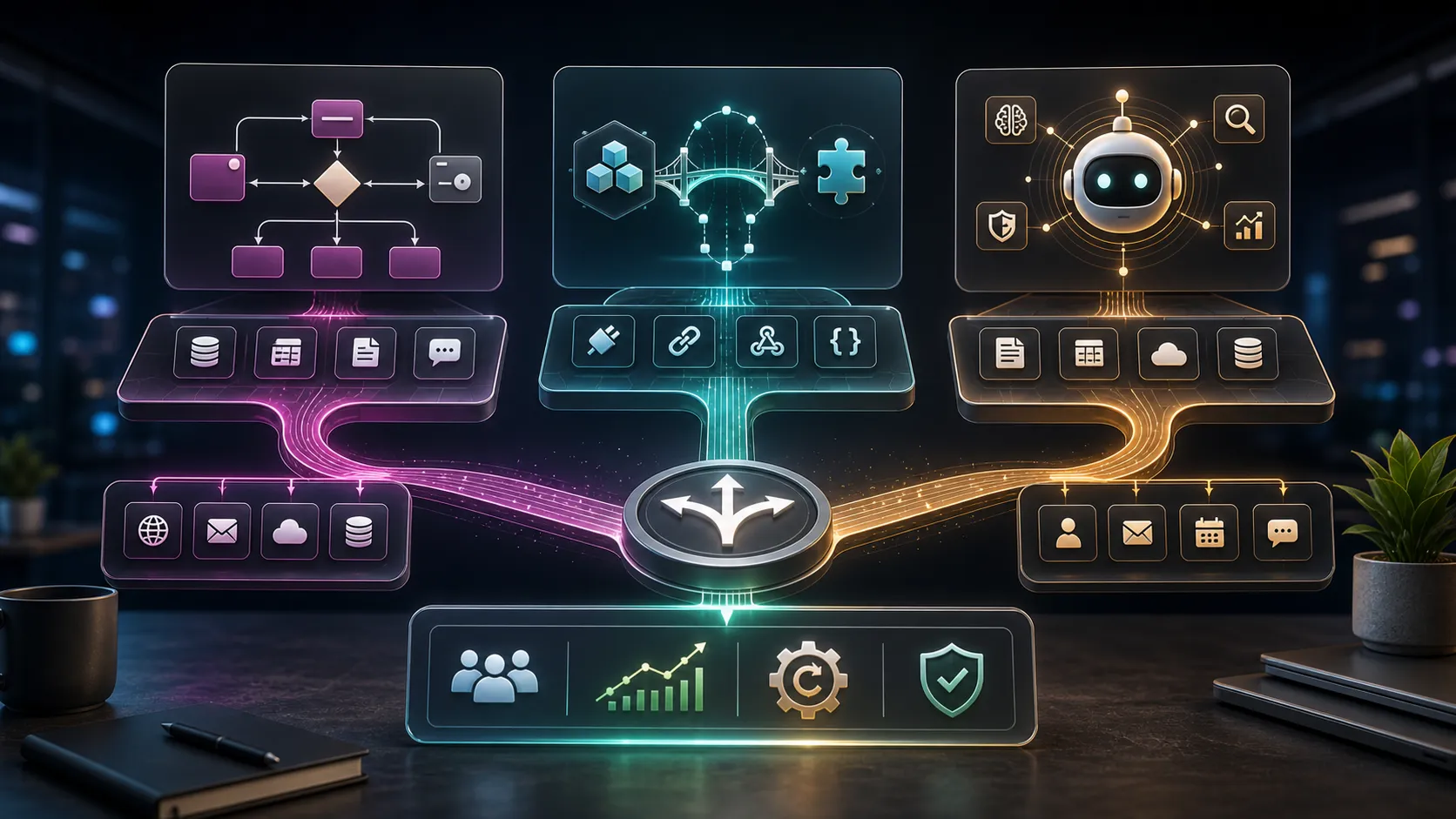
Introduction: The Architectural Shift in Enterprise Automation
The enterprise automation landscape is currently undergoing a profound structural bifurcation, shifting rapidly from rigid, rules-based logic to dynamic, probabilistic reasoning. On one side of this technological divide are traditional deterministic workflow orchestrators that connect disparate applications and move structured data with high reliability. On the other side, artificial intelligence (AI) native platforms are enabling the deployment of autonomous agents capable of contextual reasoning, dynamic adaptation, and complex problem-solving without explicit, predefined rules. This evolution represents a fundamental change in how modern organizations, from agile startups to established Florida service businesses, approach operational efficiency and scale.
Data from recent enterprise surveys underscores the staggering velocity of this transition. By 2026, analysts project that 70% of new enterprise applications will utilize low-code or no-code platforms. Simultaneously, the adoption of generative AI and agentic systems has reached an inflection point. According to McKinsey and Capgemini, 78% of organizations now utilize AI in at least one business function, an increase from 65% in early 2024. More critically, 79% of executives report that AI agents are actively being adopted within their organizations, driving the workflow automation market from a $7 billion valuation in 2025 to an estimated $10 billion in 2026. The financial implications of this shift are substantial.
Google Cloud’s recent analysis reveals that 74% of executives report achieving a return on investment (ROI) within the first 12 months of AI deployment. However, the data also highlights a widening performance gap. While top-performing organizations, representing just 6% of the market, are generating up to 10.3x returns on their AI investments by shifting their focus to agentic workflows, the majority still struggle in “pilot purgatory.” For business owners, technical directors, and operational decision-makers, selecting the correct architectural framework, whether it is the self-hosted visual nodes of n8n, the conversational tool-use of the Model Context Protocol (MCP), or fully autonomous AI agents, dictates the scalability, maintenance overhead, and ultimate success of a digital transformation initiative.
Decoding the Automation Triad: n8n, MCP, and AI Agents
To architect a resilient business automation ecosystem, an organization must understand the foundational differences in how n8n, MCP, and AI agents process data, execute tasks, and handle exceptions. These technologies are not mutually exclusive competitors; rather, they represent distinct layers within a modern, highly optimized technology stack.
n8n: The Deterministic Orchestrator
n8n is an extendable, open-source workflow automation tool designed to connect applications and services through a visual, node-based interface. Founded in 2019 and operating under a fair-code license, n8n allows organizations to self-host the platform, thereby providing deep, granular control over data privacy, custom logic, and system architecture. The core operating principle of n8n is absolute determinism. Workflows are constructed using a series of triggers and sequential nodes. When data enters the pipeline via a webhook, schedule, or API polling event, it flows through explicitly defined transformation steps, executing exactly as configured without deviation. Consequently, n8n excels in environments characterized by predictable processes, structured data formats (such as JSON objects, API responses, or relational database records), and operations where reliability and auditability are paramount. The technical and operational advantages of n8n are highly specific to data-heavy pipelines:
- Deep Developer Control: n8n permits custom JavaScript or Python code inside workflow nodes, enabling transformations that exceed pre-built integrations.
- Data Sovereignty and Compliance: Self-hosting n8n on private infrastructure gives organizations more control over data privacy, security posture, and regulatory requirements.
- Execution-Based Cost Efficiency: Unlike platforms that charge per individual node operation, n8n’s pricing model can make complex multi-step workflows more economical.
However, deterministic orchestration has limits. n8n requires technical literacy, including API authentication, data structures, and error handling. Enterprise deployments also involve real infrastructure, security, and maintenance costs. Most importantly, deterministic pipelines fail when inputs are ambiguous, unstructured, or judgment-heavy.
Model Context Protocol (MCP): The AI-Native Protocol Bridge
Choosing the automation layer

The Model Context Protocol (MCP) is an open standard developed by Anthropic that establishes a standardized, two-way connection between Large Language Models (LLMs) and external data sources or tools. Prior to the advent of MCP, integrating an AI model with an external system—such as a CRM, a proprietary database, or a specialized API—required building bespoke, brittle connections for each specific model and service combination. MCP standardizes the concept of “tool use” and function calling across the AI ecosystem, effectively serving as a universal translator between semantic reasoning and programmatic action. MCP operates natively within an AI paradigm. Instead of building a rigid, step-by-step pipeline, an operator leverages MCP by issuing natural language commands directly to an AI assistant. The AI utilizes its reasoning capabilities to determine which connected MCP tools are required, queries the necessary data, processes the information, and executes the action interactively. For example, in social media automation, an MCP server integrated with an application like BrandGhost allows a marketing operator to converse with an LLM to conceptualize, draft, refine, and schedule multi-platform content within a single interface, without ever configuring an automated trigger. This approach is highly effective for tasks requiring interactive planning, continuous context retention, and non-deterministic, creative workflows. MCP drastically reduces the time to deployment—often requiring only minutes to connect a client (like Claude Desktop) to a server via OAuth or Personal Access Tokens—but relies entirely on the cognitive capabilities, prompt adherence, and potential token limitations of the underlying LLM.
AI Agents: The Autonomous Decision-Makers
While traditional automation implies blindly following rules, and AI implies intelligence, AI Agents represent the synthesis of both: autonomous systems equipped with tools, memory, and reasoning capabilities that can independently pursue predefined goals without continuous human intervention. An AI agent is a sophisticated software architecture that observes its environment, collects unstructured data, formulates a multi-step plan, and autonomously executes a sequence of actions to achieve an objective. Agentic AI systems move significantly beyond the single-prompt limitation inherent to basic LLM interactions. They can handle highly unstructured data, iterate on their own outputs, and adapt dynamically to novel, unpredicted situations. If an AI agent is tasked with researching a competitor, it will autonomously determine the search strategy, query the web, evaluate the search results for relevance, summarize the findings, and format a final report, dynamically adjusting its approach if the initial search queries yield poor results. In enterprise contexts, AI agents are increasingly deployed for tasks where the input is messy or ambiguous, and the execution path cannot be fixed in advance. By 2026, Gartner predicts that AI agent machine customers will replace 20% of customer interactions at digital storefronts, and organizations utilizing high-maturity agentic workflows report up to 22.6% productivity gains and
15.2% cost savings. However, agents lack the predictability of n8n. Because their decisions are probabilistic rather than deterministic, they require strong governance, strict access controls, and clear audit mechanisms to prevent unauthorized system access, hallucinated outputs, or runaway API costs.
Strategic Comparative Analysis: When to Use Which Technology
The decision to utilize n8n, MCP, or AI agents must not be viewed as a mutually exclusive choice. The most sophisticated and resilient automation architectures align the technology’s core competencies with the specific operational requirement, often weaving all three into a singular fabric.
| Architectural feature | n8n deterministic workflow | MCP interactive tool protocol | AI agents autonomous systems |
|---|---|---|---|
| Core function | Explicit orchestration, API routing, and data transformation. | Standardized API bridge enabling LLM tool access. | Goal-oriented reasoning, planning, and action. |
| Operational logic | Deterministic: executes exactly as configured. | Interactive: human-in-the-loop conversational execution. | Probabilistic: dynamic decision-making based on context. |
| Data handling | Optimal for structured schemas such as JSON, SQL, or precise APIs. | Useful for unstructured conversational inputs and real-time ad-hoc data. | Strong with ambiguous, messy, or unstructured data. |
| Implementation time | Hours to days, depending on integration mapping. | Minutes when authorization and tokens are straightforward. | Days to weeks because prompt engineering and guardrails are required. |
| Best suited for | Reliable pipelines, scheduled syncing, high-volume routing, and notifications. | Creative workflows, ad-hoc data querying, guided tasks, and tool access. | Deep research, email triage, code debugging, and complex customer service. |
| Primary vulnerability | High technical barrier to entry and ongoing infrastructure maintenance. | Dependency on human operators to continuously guide the workflow. | Unpredictable execution paths, hallucinations, and runaway token costs. |
The optimal enterprise architecture frequently combines these methodologies to mitigate individual weaknesses. A highly resilient system utilizes n8n for structural stability and integrations, leveraging AI exclusively at the friction points requiring human-like judgment. In this hybrid approach, n8n acts as the execution layer, handling webhooks, retries, data formatting, and API rate limits, while an AI agent or an MCP connection serves as the cognitive decision layer, interpreting intent, extracting entities from messy text, or drafting personalized responses.
Enterprise Implementation: Practical Advice and Use Cases
To contextualize the theoretical applications of these technologies, it is essential to examine their deployment across core business functions, particularly for service businesses, agencies, and digital growth partners seeking measurable improvements in throughput.
Lead Response and CRM Operations
In customer relationship management (CRM) and sales operations, delayed lead response is a primary cause of lost revenue. Small and mid-sized enterprises frequently struggle to manage influxes of inquiries across email, social media, and web forms. A standard deterministic workflow (utilizing n8n alone) would trigger upon receiving a new web form submission, route the parsed JSON data into a CRM (like HubSpot or Microsoft Dynamics 365 Sales), and send a static, pre-written confirmation email to the prospect. While technically efficient, this approach lacks the personalization required in modern B2B interactions. Conversely, an AI Agent workflow introduces dynamic judgment. The workflow is triggered in n8n when an unstructured email arrives in a general inbox. n8n routes the raw text payload to an AI agent. The agent analyzes the semantic intent of the email, classifying it probabilistically as a “Pricing Inquiry,” a “Partnership Request,” or a “Support Ticket”. It extracts key entities (budget constraints, timelines, company names), and drafts a highly personalized, context-aware response using an LLM. The drafted response and the structured entity data are returned to n8n, which logs the interaction accurately in the CRM and places the draft in a human operator’s outbox for final review. This hybrid system ensures that the AI is not executing unpredictable, unreviewed actions directly to the client, while drastically reducing the administrative burden on sales teams by automating the triage phase.
Content Distribution and Marketing Pipelines
Content distribution represents a significant operational overhead for marketing teams. For social media operators, maintaining an active, multi-channel presence requires continuous content generation, formatting, and scheduling.
Using MCP exclusively through a platform like BrandGhost is ideal for interactive creators and community managers. The operator converses with Claude, utilizing the MCP connection to read trending news, draft a post, revise the tone interactively, and push the final asset directly to the publishing queue. However, for organizations pursuing high-volume programmatic SEO or complex content syndication, a pure n8n pipeline is superior. A multi-step, multi-source n8n pipeline can automatically aggregate content from fifty different industry RSS feeds, filter the articles deterministically by specific keywords, enrich the metadata, generate summaries via an API call to an LLM, and route the finalized content to different platform queues based on the topic. The creative judgment remains bounded within the AI step, but the ingestion and distribution logic are fully automated, running reliably on a cron schedule while the human operators sleep.
Operations, Reporting, and Data Analytics
Manual data entry and spreadsheet management remain substantial bottlenecks. Massive spreadsheets are frequently treated as makeshift databases, severely limiting querying capabilities. By implementing AI data analysts via n8n workflows, organizations can transform static spreadsheets into interactive knowledge bases. For instance, an organization can load raw financial data into a database like PostgreSQL or NocoDB. An n8n workflow connected to an SQL Query Visualizer agent can interpret natural language questions from business leaders (e.g., “What were our top-performing service lines in Q3 across the Southeast region?”), translate that semantic intent into raw SQL queries, retrieve the data, determine if a visual chart is required based on the data density, and utilize an API (such as QuickChart) to plot the data. This empowers non-technical stakeholders to access deep business intelligence instantaneously, accelerating the speed of operational decision-making without requiring intervention from a data engineering team. Furthermore, within the advertising technology sector, AI is transforming how return on ad spend (ROAS) is calculated. The historical divide between top-of-funnel “awareness” media and downstream “performance” media is dissolving. At events like POSSIBLE Miami 2026, the industry consensus indicated a shift toward “Agentic Multilocation” strategies. Adtech platforms utilize AI to connect early digital out-of-home (DOOH) exposure data with downstream CRM engagement signals, allowing brands to plan, retarget, and optimize campaigns with precision, turning physical advertising into an accountable, measurable pipeline.
Florida Business Context: Adopting Automation in Regional Markets
The adoption of these advanced automation paradigms is highly localized, influenced heavily by regional economic drivers, infrastructure resilience requirements, and specific industry compositions. In Florida—specifically across hubs like Miami, Hialeah, Fort Lauderdale, and Orlando—the real estate, logistics, tourism, and small business service sectors are driving rapid, pragmatic digital transformation.
Real Estate, IoT, and Digital Twins
The Florida real estate market is undergoing a profound technological shift throughout 2025 and 2026, pivoting from traditional sales models to highly analytical, data-driven property management and development. The integration of the Internet of Things (IoT), AI, and digital twins is fundamentally reshaping the sector. IoT devices embedded in smart homes—including security systems, connected appliances, and smart HVACs—generate massive datasets regarding energy usage, spatial utilization, and daily routines. Forward-thinking real estate developers and agencies in South Florida are utilizing AI to process this unstructured IoT data. By combining this data with advanced imagery, developers construct dynamic digital twins (virtual replicas) of physical properties. These digital twins allow algorithms to simulate interactions, offering predictive analytics regarding consumer preferences and enabling the optimization of sustainable, eco-friendly housing designs. For a Miami-based interior design firm or real estate agency, deploying automated n8n data pipelines to capture, structure, and analyze client preferences alongside smart home data allows for hyper-personalized service delivery, aligning perfectly with the growing consumer demand for energy-efficient residences equipped with sophisticated automation systems.
Logistics, Cloud Migration, and Disaster Resilience
South Florida’s strategic position as a premier logistics and distribution gateway to Latin America necessitates robust enterprise resource planning (ERP) and highly optimized supply chain management. Organizations across the state are rapidly executing cloud-first strategies, utilizing platforms like Microsoft Dynamics 365 Business Central to achieve unified financial reporting, real-time inventory tracking, and electronic data interchange (EDI) integration. A critical, localized driver for this cloud migration in Florida is disaster resilience. South Florida’s susceptibility to seasonal hurricanes mandates that critical IT infrastructure remains securely accessible during natural disasters. Transitioning legacy on-premise systems to secure cloud environments and automating critical data backups via deterministic n8n pipelines ensures absolute business continuity. Furthermore, local logistics enterprises are deploying AI-powered CRM systems to personalize customer interactions and predict supply chain disruptions, allowing them to maintain service level agreements (SLAs) during high-stress environmental events.
The Small Business “AI Stack” in Florida
Small businesses and local service providers in Florida are adopting AI aggressively, bypassing theoretical applications to focus squarely on practical pain points. Recent survey data published by the SBE Council indicates that 82% of small business employers have already invested in AI tools, with 93% planning to continue or increase that investment over the next twelve months. The typical implementation playbook for a small business in Miami or Hialeah begins with identifying a specific workflow characterized by high friction, such as customer support triage, proposal drafting, or financial data entry. These businesses are constructing an “AI Stack,” utilizing a median of five distinct applications simultaneously.
The Modern Florida Small Business AI Stack
| Layer | Role in the stack |
|---|---|
| Core AI assistants | Platforms like ChatGPT or Claude act as the central hub for drafting marketing copy, formulating proposals, and answering ad-hoc operational queries. |
| Marketing and content | Automated programmatic content generation and multi-channel distribution pipelines. |
| Customer service | Agentic chatbots utilizing semantic search to resolve tier-1 client inquiries. |
| Administrative automation | n8n or low-code platforms handling repetitive data entry, CRM syncing, and scheduling. |
| Financial management | AI-driven forecasting and advanced pricing optimization tools, rapidly emerging as a primary growth driver. |
The key to success for local enterprises is designing workflows for “human review, not human replacement,” ensuring that AI accelerates judgment but leaves final high-stakes decisions and client relationship management to experienced human operators.
Integrating the Stack: Building n8n with MCP and Agents
To move beyond isolated, fragmented tools and architect a cohesive, enterprise-grade automation engine, organizations must integrate these divergent technologies. The recent introduction of Model Context Protocol capabilities directly into the n8n ecosystem represents a massive architectural leap forward. This integration allows deterministic visual workflows to directly expose their logic to external LLMs, or conversely, allows n8n to utilize external MCP servers as modular tools.
Technical Implementation: Exposing n8n to MCP Clients
n8n can be configured to act as an MCP server, securely exposing specific workflows as “tools” that external AI clients (like Claude Desktop or Lovable) can trigger and execute. To architect this infrastructure:
- Enable Instance-Level Access: In a self-hosted or Cloud n8n instance that supports MCP access, administrators enable the instance-level MCP setting.
- Workflow Curation and Guardrails: Specific workflows are marked as available through MCP. This curation is critical because an external AI should not be able to trigger sensitive pipelines such as payroll execution or database deletion. Clear workflow descriptions help the connected LLM understand when and how to use each tool.
- Authentication Protocols: Clients connect securely through OAuth2 or personal access tokens. For example, a Claude Desktop connection can point to the remote n8n base URL with a generated token.
- Conversational Execution: Once authenticated, a user can ask an assistant to analyze a report and update a client record. The assistant recognizes the available n8n MCP tool, sends the structured payload to n8n, and n8n executes the deterministic CRM update in the background.
Technical Implementation: Utilizing External MCP Servers within n8n
Conversely, n8n can act as an MCP Client, leveraging external AI tools directly within its visual pipeline by utilizing the community-built n8n-nodes-mcp node.
- Deployment: Organizations deploy a self-hosted n8n environment using infrastructure such as AWS, Zeabur, Fly.io, or another approved runtime.
- Node Installation: Administrators install the MCP community node package from n8n’s community node settings when that package is appropriate for the environment.
- Credential Configuration: A new MCP client credential defines the command to start the server, required arguments, and secure environment variables for API keys.
- Agent Assembly: An Advanced AI Agent node connects to the MCP client tool. The agent can list available tools, choose the correct resource, execute the tool, and return structured output to the broader n8n workflow.
This bidirectional integration bridges deterministic n8n control with probabilistic AI reasoning, creating a system that is more intelligent while remaining auditable.
Common Mistakes and Governance Considerations
The rapid deployment of AI and automation is fraught with significant operational and financial risks. Organizations that fail to implement proper governance structures frequently encounter the “pilot purgatory” phenomenon, where isolated experiments succeed locally but fail catastrophically when attempting to scale enterprise-wide.
- Ignoring Data Quality: AI models depend on the quality, structure, and accuracy of their data context. Fragmented databases, duplicate records, and legacy inaccuracies lead to confident but wrong outputs. Data cleaning and governance should come before conversational interfaces over operational systems.
- Over-Engineering with Agents: A common architectural error is using an expensive LLM agent for work that a deterministic rule in n8n can handle. If the steps are known in advance, hard-code the logic and reserve agents for ambiguity, interpretation, or complex decisions.
- Neglecting Change Management and Security: Skipping cybersecurity review, vendor review, employee training, or compliance controls undermines adoption and increases risk. Strong AI implementations pair the technical system with process redesign, training, and clear ownership.
The Intersection of Automation and SEO/GEO Growth
As search ecosystems undergo radical transformations, the integration of automation into marketing and digital growth strategies is no longer a luxury; it is an operational necessity. Traditional Search Engine Optimization (SEO) relied heavily on static keyword placement, technical site speed, and manual backlink outreach. However, the rise of AI-driven search engines and conversational interfaces has introduced the concept of Generative Engine Optimization (GEO).
The primary objective of GEO is to architect and structure digital content so that it is accurately ingested, cited, and synthesized by generative AI models like ChatGPT, Perplexity, and Google’s AI Overviews. For a local service business operating in competitive markets like Hialeah or Orlando, achieving visibility requires moving beyond basic local directory listings; it requires establishing deep semantic relevance, topical authority, and clearly defined entity relationships. Advanced automation serves as the foundational engine for scalable GEO execution. By utilizing n8n pipelines integrated seamlessly with MCP-enabled LLMs (such as Claude 3.7), technical SEO specialists can construct automated keyword research engines capable of analyzing high-intent, long-tail search opportunities at an unprecedented scale. These agentic systems autonomously scrape competitor sites, analyze shifts in search intent, structure complex data schemas, and generate localized, programmatic SEO content that addresses highly specific regional queries, effectively condensing manual, multi-week research tasks into automated, daily routines.
When to Build, When to Automate, and When to Optimize
Determining the exact sequence and priority of a digital transformation initiative requires a holistic view of the organization’s existing infrastructure. Attempting to automate a broken process only accelerates the rate of failure.
-
When to Build: If a business lacks foundational digital infrastructure, such as a modern, responsive website, a secure customer portal, or a centralized, clean database, automation cannot succeed. The prerequisite to AI integration is customized, structured software. SaaS MVP development is critical when an organization needs to prototype a proprietary internal tool or reporting dashboard before attempting to automate data flow across disparate legacy systems. Similarly, robust full-stack web development ensures that web properties are structurally sound, API-ready, and capable of securely handling automated webhook traffic.
-
When to Automate: Automation becomes the logical next step once a business experiences measurable operational friction due to manual, repetitive tasks, data silos, or delayed customer responses. If an organization is manually moving data between a CRM and an email client, utilizing n8n pipelines can eliminate the bottleneck entirely. For processes requiring dynamic reasoning, such as advanced data extraction or real-time intent classification, investing in specialized AI workflow automation or Model Context Protocol integration ensures the system can handle complexity without breaking under ambiguity.
-
When to Optimize (SEO/GEO): Once the underlying software is built and the operational processes are automated, the focus must shift aggressively toward customer acquisition and revenue growth. Optimization involves leveraging the newly structured data to capture market share. This includes deploying advanced technical SEO frameworks to dominate AI-driven search results, utilizing localized service pages to capture long-tail regional traffic across Florida, and building dynamic follow-up systems to nurture the leads captured and qualified by the automated CRM pipelines.
Conclusion and Next Steps
The evolution from rigid, rules-based task automation to intelligent, agentic systems presents an unprecedented opportunity for operational leverage and financial scaling. Traditional automation tools like n8n provide the necessary deterministic backbone, ensuring data privacy, reliable high-volume routing, and stable infrastructure management. Conversely, the Model Context Protocol and autonomous AI agents introduce probabilistic reasoning, enabling systems to interact conversationally, handle vast amounts of unstructured data, and dynamically adapt to complex business challenges.
For business owners, technical directors, and enterprise teams, long-term success lies not in selecting one technology to the exclusion of the others, but in orchestrating them into a cohesive, secure digital ecosystem. By integrating custom software architecture, intelligent agentic workflows, and advanced GEO growth strategies, organizations can drastically reduce administrative friction, accelerate executive decision-making, and drive measurable revenue growth. Organizations seeking to deploy secure n8n infrastructures, develop custom autonomous AI agents, or launch data-driven programmatic SEO campaigns should schedule a discovery call with a technical partner capable of connecting complex API integrations directly to tangible business outcomes.
Works Cited
-
n8n vs AI-Native Automation Platforms: Which Should You Choose …
-
AI Use Cases and Key Statistics and Trends for 2026 - Itransition
-
State of AI 2025 Report: 78% Adoption, 74% See ROI — McKinsey & Google Data - punku.ai
-
MCP vs n8n for Social Media Automation: Which Should You Use …
-
Agents vs Automation: The Future of Workflows Explained with n8n - YouTube
-
How to Implement AI in Your Company: A Practical Miami Playbook for 2026
-
Best 9 n8n AI agent workflow automation examples in 2026 | The Jotform Blog
-
Top Digital Transformation Trends for Florida Businesses in 2025 | Blog
-
Tech Trends to Reshape Your Real Estate Business | Florida Realtors
-
The Future of IT: Trends South Florida Businesses Need to Know - Comsys
-
Florida Real Estate Trends: Navigating the Market in 2025 - SDV and Partners
-
The Ultimate n8n MCP Step-by-Step Guide for Beginners | 2026 - Generect
-
MCP vs n8n vs API Integration: Choosing the Right Automation Layer - Raff Technologies
-
How Florida Businesses Can Use AI to Cut Costs in 2026 - Zevonix
-
Generative Engine Optimization (GEO): The 2026 Guide to AI Search Visibility - LLMrefs
-
Local SEO and GEO for Local Businesses: The Complete Guide to
-
How to Automate High-Intent Keyword Research with n8n, MCP, and Claude 3.7 - Stormy AI