
The Macroeconomic and Digital Landscape of South Florida
The economic velocity of South Florida has fundamentally transformed the commercial landscape, necessitating highly sophisticated digital acquisition strategies for businesses operating within the region. The broader Miami metropolitan area currently boasts a $219 billion Gross Domestic Product (GDP) and ranks in the top five worldwide for millionaire growth. What was once primarily a tourism and real estate-driven economy has rapidly ascended to become the fourth-largest startup hub in the United States, with a local innovation ecosystem now valued at $36 billion. Between 2021 and 2023, venture capital investment in the area surged by 200%, elevating Miami’s global startup ranking from 23rd to 16th place.
This macroeconomic acceleration is not occurring in a vacuum. Significant regulatory and tax incentives continue to drive corporate migration to the state. The absence of a state income tax has long been a draw, but recent legislative adjustments further incentivize business expansion. Specifically, the commercial lease sales tax (Business Rent Tax) in Florida was recently reduced from 4.5% to 2.0%, providing an estimated $1 billion in tax relief to Florida employers, and effective October 1, 2025, the commercial rent tax is slated for complete elimination. This regulatory environment translates directly into operational savings that forward-thinking businesses are aggressively reinvesting into digital infrastructure, software development, and market share acquisition.
Adjacent to the urban core of Miami, the city of Hialeah is undergoing a parallel and equally aggressive economic revitalization. As the sixth-largest municipality in Florida with over 224,000 residents living within a densely populated 20-square-mile radius, Hialeah is actively shifting from its traditional working-class industrial roots to a modernized economic center. The strategic geographical positioning of Hialeah provides direct logistical advantages, bordered by Opa-Locka, Miami, and Miami Lakes, while offering immediate access to critical transit arteries like I-75, the Palmetto Expressway, and the Florida Turnpike. The modernization of Hialeah is perhaps best exemplified by the development of the Amelia District, a massive, unified mixed-use destination designed to integrate residential living, retail commerce, and hospitality venues such as Amelia Live and The Yards. This influx of capital and infrastructure modernization is further reflected in real estate metrics. In the Hialeah/Miami Lakes submarket alone, 1,218 multifamily units are currently under construction as of Winter 2025, representing 5.6% of the total massive multifamily pipeline in the broader Miami metropolitan area.
| Indicator | Market data | Strategic implication for service businesses |
|---|---|---|
| Miami Metropolitan GDP | $219 billion | Massive capital liquidity driving B2B and B2C service demand. |
| Venture capital investment | $5+ billion in 2024 | High concentration of tech, HealthTech, and FinTech startups requiring digital infrastructure. |
| Total nonfarm employment | 3,017,400 in December 2024 | Expanding workforce necessitating localized B2B operational support. |
| Construction industry job growth | +5.9% year over year | Explosive demand for contractor, real estate, and logistical service providers. |
| Hialeah population density | 224,000+ within 20 square miles | Hyper-dense consumer base requiring granular, neighborhood-level targeting. |
| Hialeah/Miami Lakes real estate | 1,218 units under construction | Influx of new residents requiring home services, logistics, and retail. |
| Commercial rent tax reform | Eliminated October 2025 | Frees operational capital for reinvestment into web development and local SEO. |
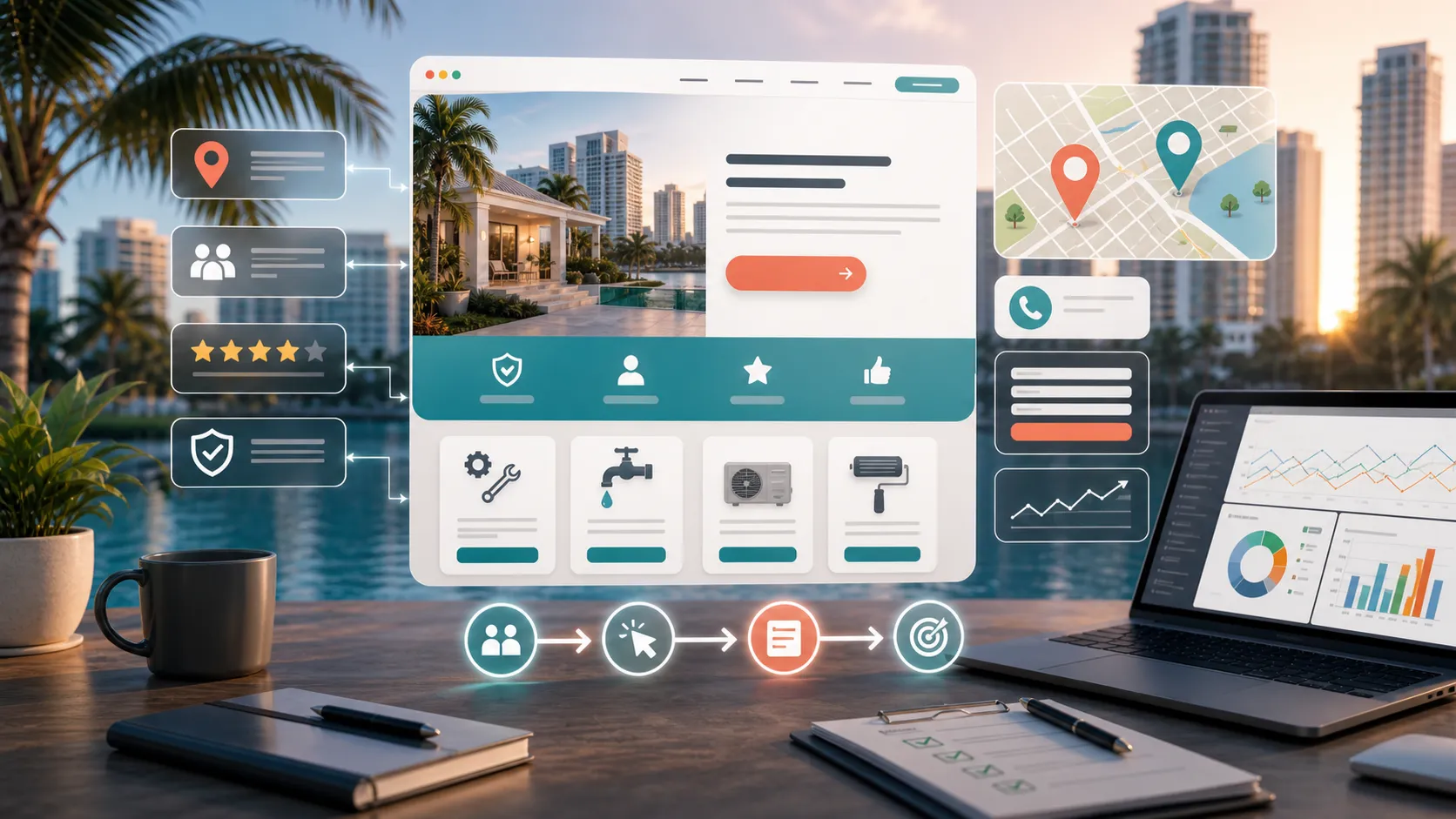
Local landing page conversion system

This explosive economic and population growth creates a hyper-competitive digital ecosystem. For a local service business, a traditional, monolithic website is no longer sufficient to capture localized search intent. Consumers in this market are highly connected; over 70% of all local searches originate from mobile devices, and the majority of these “near me” queries lead to an action or purchase within 24 hours. To capitalize on this immediate intent, businesses require granular, highly optimized, and automated landing pages tailored to specific neighborhoods, industries, and search behaviors.
The Anatomy of a High-Converting Local Landing Page
The architecture of a high-converting landing page for a service business cannot rely on generic content or replicated, low-effort templates. Search engine algorithms in 2025 and 2026 heavily prioritize the trifecta of local search: Proximity, Prominence, and Relevance. If a user in Hialeah searches for a commercial HVAC contractor, a page optimized generically for “South Florida” will be outranked by a page demonstrating exact proximity and relevance to Hialeah. To capture high-intent localized queries, landing pages must be architected with localized precision at both the content and technical levels.
Granular Localization and Community Integration
The most effective strategy for regional visibility is the deployment of hyper-local landing pages designed for specific municipal boundaries and distinct neighborhoods. Rather than a single “Service Area” page that lists dozens of cities in a comma-separated format, technical best practices dictate the creation of distinct, indexable web assets for each target location. However, scaling these pages requires extreme caution. A common and heavily penalized practice is creating a “Frankenstein” of thin content by duplicating text and simply swapping out the city name (e.g., replacing “Miami” with “Hialeah”). Search engines easily identify this as manipulative, low-value content. Instead, each local landing page must establish immediate relevance and trust through unique, hyper-local elements:
- City-Specific Value Propositions: Tailoring the core offering to the location. Instead of a generic “Over 10 Years of Experience,” a significantly more effective headline is “Delivering Compliance-Driven Corporate IT Solutions in Downtown Miami Since 2015” or “We’ve reroofed 127 homes in Hialeah Gardens since 2019.” This grounds the business in objective, local reality.
- Local Project Spotlights: Embedding mini-case studies that feature before-and-after documentation of projects completed within the specific city. Including the neighborhood, with client consent, and a brief narrative provides undeniable proof of local operational capacity and competence.
- Neighborhood Highlights and Wayfinding: Naturally integrating references to local landmarks contextualizes the business within the physical community. Mentioning proximity to the Miami Health District when targeting medical clients, or referencing operations near Amelia Earhart Park in Hialeah, signals to both the user and the search engine that the business possesses authentic local knowledge.
- Service-Area Map Integrations: Embedding localized map data containing service area pins is critical. However, rather than simply embedding a single Google Map of the main headquarters, advanced landing pages drop maps of real job locations, represented as general area pins rather than exact addresses, within that specific city hub.
- Hyper-Local FAQs: Addressing location-specific concerns builds immense authority. For example, a roofing contractor might address specific municipal building codes required in Hialeah, hurricane-season preparation protocols for Miami coastal properties, or the specific HVAC requirements necessary to combat South Florida humidity.
- Service-Specific Local Pricing Ranges: Price opacity causes massive bounce rates. Providing generalized ranges tied to local averages sets immediate expectations and qualifies leads before they even submit a form. For example, “Commercial network installations in the Brickell district typically range between $X and $Y depending on square footage.”
Overcoming Technical SEO and JavaScript Hurdles
The infrastructure supporting a landing page is as critical as its visible content. Many large organizations and local businesses alike fail at local SEO because they rely on JavaScript-heavy store locators or dynamic routing that search engine crawlers struggle to index. When a user searches for a service in a specific location, Google needs to discover, crawl, and index a dedicated page for that location. If local store pages are hidden behind postcode lookup tools or interactive maps that require JavaScript interaction, the internal links to those local pages remain invisible to search engine bots. This reliance on client-side rendering without proper server-side architecture results in poor discoverability. The technical solution requires generating unique, static, and indexable URLs for every service location, such as /hialeah-custom-software-development or /miami-ai-automation-consulting. Furthermore, these pages must pass Core Web Vitals metrics. With mobile dependency dictating search behavior, page load velocities, interactivity, and visual stability are non-negotiable ranking factors. A slow landing page will suffer severe algorithmic suppression regardless of how well the content is written.
Structured Data and Schema Markup Strategy
To compete effectively in the sophisticated Miami market, landing pages must utilize JSON-LD schema markup. Schema is a specialized form of code that translates the page’s unstructured content into a highly organized, standardized data format that search engines can easily parse and categorize. Implementing localized structured data serves as a direct line of communication to the search engine, explicitly stating the entity’s identity, physical location, and service offerings. The most critical schema implementations include:
- LocalBusiness Schema: Deploy this on a per-city basis. It should detail specific geo-coordinates, local business hours, accepted payment methods, and precise service area boundaries.
- FAQPage Schema: Marking up the hyper-local FAQs with this schema significantly increases the probability of capturing rich snippets and dominating real estate in “People Also Ask” sections.
- Review Schema: Aggregating local review data and marking it up allows star ratings to appear directly beneath the URL in search results. This visual trust signal can dramatically improve click-through rates compared to competitor listings lacking visual review data.
Generative Engine Optimization (GEO) in the AI Era
While traditional SEO focuses on optimizing for the Google Local Pack and organic blue links, the paradigm is shifting rapidly toward Generative Engine Optimization (GEO). In 2025 and 2026, consumers increasingly rely on AI-driven answer engines, Large Language Models (LLMs) like ChatGPT and Claude, and AI Overviews embedded directly within traditional search interfaces. When a user inputs a complex, highly specific query, such as “Which B2B IT service providers in Miami have experience integrating AI workflows for healthcare compliance?”, traditional search intent matching falls short. Generative AI models attempt to synthesize an exact answer by drawing upon entities that demonstrate the highest authority, deepest topical coverage, and most structured data.
Tactics for AI Search Visibility
Optimizing for generative engines requires a strategic departure from traditional keyword targeting. Generative models are trained to extract facts, verify entity relationships, and present synthesized intelligence.
- Deep Entity Resolution: AI models reference trusted, high-authority nodes across the web. A business must establish a clear, unambiguous digital entity through consistent Name, Address, and Phone number (NAP) data across directories, chambers of commerce, and industry associations. If the data is fragmented, an LLM cannot confidently recommend the business.
- Conversational and Comprehensive Content: Thin content is immediately discarded by LLMs. Landing pages must answer questions thoroughly using a conversational tone that matches how users speak to voice assistants and AI interfaces. Deep resource guides, such as “The Complete Guide to Commercial Zoning Regulations in Hialeah for New Businesses,” provide the informational density AI models prefer to cite.
- E-E-A-T Principles: Experience, Expertise, Authoritativeness, and Trustworthiness are paramount. Technical certifications, precise case studies with measurable outcomes, and verifiable data points train AI systems to recognize the brand as a credible authority.
Optimization Strategy: Local SEO vs. GEO
| Optimization area | Traditional local SEO focus | Generative Engine Optimization focus |
|---|---|---|
| Primary target | Google Maps local pack and organic top 10 results | AI Overviews, Perplexity answers, and ChatGPT citations |
| Keyword strategy | “Near me,” “in [City],” and search volume | Conversational queries, long-tail semantic context, and topic clusters |
| Content structure | Standard H1/H2 hierarchy and keyword relevance | Deep Q&A formats, high information density, and unique expert insights |
| Trust signals | Google Business Profile reviews, backlinks, and NAP consistency | Citations by authoritative entities and consistent entity relationships |
| Technical implementation | Basic HTML optimization, page speed, and crawlability | Exhaustive JSON-LD schema and clear entity-relationship mapping |
Integrating AI Automation for Lead Capture and CRM
A highly optimized landing page that successfully captures organic traffic and generates high-intent leads will ultimately fail to produce revenue if the backend lead response mechanisms are slow or disjointed. The traditional model, where a prospect submits a contact form and that submission sits unread in a generic inbox for hours, is obsolete. Modern service businesses operating in dynamic, high-velocity markets like Miami must transition from static contact forms to intelligent, automated lead workflows. The concept of “speed to lead” dictates that the probability of qualifying a lead drops exponentially with every minute that passes after the initial inquiry.
Advanced n8n Webhook Infrastructures
To bridge the gap between user intent and operational execution, businesses must deploy sophisticated automation platforms, with n8n standing out as a premier tool for custom workflow orchestration. When a user submits a project inquiry or requests a discovery call on a Hialeah landing page, an automated webhook infrastructure can execute a complex sequence of operations within milliseconds.
- Real-Time Data Extraction and Enrichment: The moment the form is submitted, the n8n workflow captures the basic input data. It then immediately routes this data through AI-powered extraction tools or enrichment APIs. If the user provided a corporate email address, the system automatically pulls the company’s domain, extracts professional context, estimates company size, identifies the industry, and assesses potential revenue fit.
- Intelligent Lead Scoring and CRM Routing: Armed with this enriched dataset, the automation workflow applies custom logical conditions to score the lead. The structured data is then pushed directly into the company’s CRM system. The lead is automatically tagged based on criteria such as “Miami Logistics,” “High-Value Decision-Maker,” or “Urgent Hialeah Repair.”
- Automated, Context-Aware Response Sequences: Instead of a generic “Thank you for contacting us” auto-responder, an integrated LLM agent instantly generates a personalized email or SMS. This response acknowledges the specific nature of the inquiry, references the user’s location, and provides an immediate calendar link to schedule a discovery call. By the time a human sales representative reviews the CRM, the lead has already been enriched, qualified, scored, and engaged.
AI Agents and Conversational Interfaces
Beyond optimizing standard forms, embedding custom AI chatbots trained specifically on the business’s proprietary knowledge base provides a highly interactive conversion pathway. These are not the rigid, decision-tree chatbots of the past. By leveraging Model Context Protocol integration and connecting directly to underlying LLMs, these AI agents can interact with website visitors 24/7. They understand nuanced natural language and can answer complex questions about specific local availability, pricing structures, and technical capabilities. For instance, if a user on a Miami software development landing page asks, “Do you have experience building HIPAA-compliant portals for local clinics?”, the AI agent can affirmatively answer, summarize a relevant local case study, collect the user’s technical requirements, and escalate the highly qualified lead to a senior developer automatically.
Industry-Specific Market Nuances in South Florida
A one-size-fits-all approach is deeply flawed when targeting the South Florida economy. The Miami and Hialeah markets are highly diversified, requiring landing pages and digital strategies to be carefully calibrated to the specific expectations, regulatory environments, and search behaviors of different sectors.
Healthcare and HealthTech
The healthcare sector remains one of Miami’s largest economic drivers. The Miami Health District ranks as the second-largest medical district in the United States, supporting over 1,000 life science companies and employing more than 100,000 industry professionals. For B2B companies providing software, automation, or marketing services to this sector, landing pages must prioritize rigorous, clinical trust signals. Content in this vertical must navigate strict regulatory frameworks. Landing pages must explicitly address HIPAA compliance, secure data handling, remote patient monitoring protocols, and potential FDA approval processes where applicable. The brand tone must be highly authoritative, data-driven, and backed by verifiable security certifications.
Fintech, Web3, and Finance
Miami has rapidly evolved into a major financial hub, attracting massive influxes of hedge funds, venture capital, and alternative investment firms. Furthermore, the city is experiencing a fintech evolution, with approximately 500 fintech startups focused on blockchain, digital assets, and Web3 technologies calling Miami home. Landing pages targeting this demographic require a distinctly modern, high-performance architectural approach. The content should focus intensely on technical capabilities: API integrations, latency reduction, large-scale data processing speeds, and robust cybersecurity infrastructure. Visual elements should reflect a high-tech ecosystem, and the integration of real-time data dashboards as trust signals is highly effective. The audience in this sector possesses deep technical literacy, and the landing page copy must reflect an expert-to-expert communication style.
Logistics, Trade, and Advanced Mobility
Positioned strategically as the gateway between the United States, Latin America, and the Caribbean, Miami’s PortMiami and Miami International Airport (MIA) facilitate billions of dollars in global trade annually. Businesses serving the logistics, supply chain, and advanced mobility sectors must emphasize operational efficiency, international transit capabilities, and real-time tracking software integration. Furthermore, given the fundamental multilingual nature of Miami’s workforce—where the majority speak Spanish at a native level—and its international client base, implementing a comprehensive bilingual (English and Spanish) content strategy is mathematically advantageous. Failing to optimize a logistics or trade landing page for Spanish search queries essentially abandons a massive percentage of the total addressable market to competitors.
Real Estate, Construction, and Local Services
For traditional local services (HVAC, plumbing, legal, accounting) and the booming real estate sector, granular localization is the primary driver of success. As evidenced by the massive construction job growth (5.9% YoY) and the thousands of multifamily units under development across downtown Miami, Aventura, Coral Gables, and Hialeah, the demand for localized service providers is immense. Neighborhood-specific targeting is essential. Landing pages should leverage high-quality visual documentation of local properties, detailed area guides, and hyper-localized market insights to establish community authority. For example, a real estate developer or contractor operating in the Amelia District of Hialeah should feature content directly addressing the revitalization efforts and specific zoning considerations of that immediate area.
Common Mistakes and Strategic Pitfalls
Despite the availability of advanced digital tools and widespread knowledge of basic SEO principles, many businesses consistently fail to capture local market share due to critical implementation errors.
-
Ignoring Online Reputation Management (ORM): A technically perfect, high-ranking landing page will fail to convert traffic if the business’s Google Business Profile has poor or nonexistent reviews. Consumers trust peer validation. Attempting to manipulate this system with fake or incentivized reviews risks algorithmic penalties and profile suspension. Reputation management should request authentic feedback through SMS or email workflows after successful service delivery.
-
Keyword Stuffing and Robotic Copywriting: Attempting to manipulate search rankings by awkwardly forcing localized keywords into the text, such as “We are the best local roofer Miami providing local roofer Miami services to Hialeah residents,” damages the user experience and triggers immediate algorithmic penalties for spam. Modern search algorithms rely on natural language processing; content must be written for human comprehension first, allowing the AI to organically infer geographical relevance.
-
Inconsistent NAP Citations: Discrepancies in a business’s Name, Address, and Phone number across various online directories fragment the business’s digital entity. This lack of uniformity erodes trust with search engines, directly suppressing visibility in local map packs. Maintaining absolute uniformity across the entire digital ecosystem is a foundational requirement.
-
Neglecting Mobile-First Optimization: Over 60% to 70% of local searches happen on mobile devices. If a landing page features unreadable text, broken responsive layouts, or CTA buttons that are difficult to tap on a smartphone screen, the user will immediately bounce back to the search results. This high bounce rate signals a poor user experience to Google, resulting in a loss of rankings.
Strategic Decision Matrix: When to Build, Automate, Optimize, or Partner
Navigating digital growth in a market as complex as South Florida requires precise allocation of capital and resources. The following framework assists business owners and technical decision-makers in determining the appropriate operational phase for their digital assets.
When to Build
A foundational build phase is strictly required when current digital assets are structurally incapable of competing in the modern landscape. Key indicators include a reliance on slow, single-page monolithic websites, an inability to programmatically generate unique URLs for specific service areas, or an architecture heavily reliant on non-indexable JavaScript frameworks. Building a robust, scalable web application or a modular CMS-driven landing page system establishes the necessary baseline for future growth.
When to Optimize
Optimization is the correct strategic phase when the structural foundation exists, but organic traffic acquisition is lagging behind competitors. This involves conducting exhaustive technical SEO audits, refining on-page conversational content, deploying structured data schema per location, improving Core Web Vitals to pass Google’s thresholds, and engaging in programmatic SEO to scale location-specific content without triggering duplication penalties. Furthermore, transitioning strategy from traditional SEO to Generative Engine Optimization (GEO) ensures visibility in AI-curated search results.
When to Automate
Automation becomes critical when traffic and leads are successfully generated, but operational bottlenecks prevent efficient conversion and scaling. If lead response times consistently exceed five minutes, if sales and marketing teams are manually transferring data between email
inboxes and CRMs, or if lead qualification processes are labor-intensive, implementing AI workflows and n8n integrations is mandatory to protect the return on investment (ROI) of marketing spend. Automation solves the human bandwidth problem.
When to Contact a Professional
Attempting to synchronize complex full-stack web development, multi-location technical SEO, and advanced AI API automation internally often far exceeds the capacity of standard in-house marketing teams or basic web design agencies. When the business objective requires connecting highly technical digital implementations directly to measurable business outcomes—such as integrating local search visibility with automated CRM routing and dynamic lead qualification—engaging a specialized digital growth technical partner is the most efficient and cost-effective path forward.
Conclusion and Strategic Imperatives
The markets of Hialeah and Miami represent some of the most dynamic, heavily funded, and rapidly expanding commercial environments in the United States. However, the density of competition, combined with the rapid evolution of search technologies and AI integrations, demands an uncompromising approach to digital infrastructure. Surviving and scaling in this ecosystem requires moving beyond basic brochure websites toward highly engineered, localized, and automated landing pages. By integrating hyper-local content strategies, rigorous technical SEO, Generative Engine Optimization, and sophisticated AI-driven lead automation workflows, service businesses can establish dominant market visibility and construct seamless, high-velocity conversion pipelines. For enterprises, startups, and service businesses seeking a dedicated technical partner to connect strategy, implementation, and analytics to measurable revenue growth, the next step is to schedule a discovery call.
Works Cited
-
Best Businesses to Start in Miami (2025 Guide) - Davinci Virtual
-
Local SEO Checklist 2025: How to Optimise “Near Me” Searches - Shyam Future Tech
-
Ultimate Miami SEO Services Guide for 2025 - Sky SEO Digital — AI-Powered SEO, GEO & AEO Agency
-
25 Local Service Page Ideas That Actually Rank in 2025 - Pixelvolution
-
Generative Engine Optimization (GEO): Teach AI Who You Are - Salesforce
-
How to Improve Small Business AI Search Visibility with GEO - U.S. Chamber of Commerce
-
Local SEO for Miami Businesses: Get Found in 2025 - Roman Novoa
-
7 Lead Generation Automation Workflows That Actually Convert | ProfileSpider Blog
-
Discover 649 Lead Generation Automation Workflows from the n8n’s Community
-
SEO Optimization Miami FL: Unlock Your Potential 2025 - ROI Amplified