
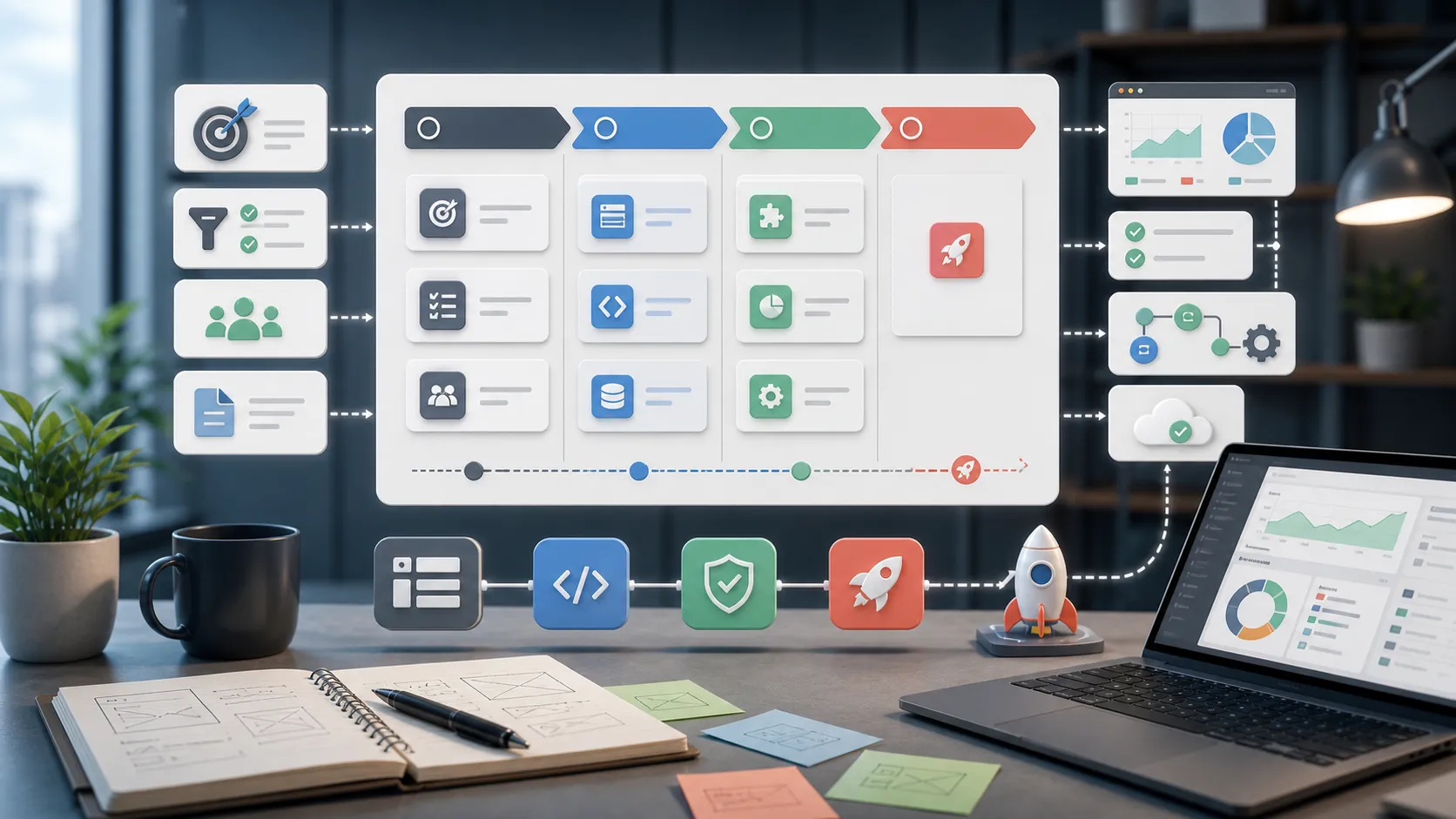
A SaaS MVP can be built in 4 weeks if the scope is locked before development starts. The goal is not a complete product; it is a working version that validates one user, one problem, and one paid or measurable action.
Quick answer: You can build a SaaS MVP in 4 weeks by limiting the product to one core user, one core workflow, one measurable outcome, and one launch-ready version. Week 1 defines scope and architecture, Week 2 validates the user experience, Week 3 builds the core product, and Week 4 handles QA, analytics, launch, and feedback.
The mistake most founders make is trying to compress a six-month product into a four-week timeline. That creates a slow, fragile build. A real 4-week MVP works because the team cuts everything that does not support the first meaningful user outcome.
Use this guide if you need a practical roadmap for a focused SaaS MVP, a technical scope checklist, and a launch plan that connects product discovery, full-stack engineering, automation, analytics, and SEO/GEO visibility. If you already know the idea but need help turning it into a buildable version 1, start with the SaaS MVP development service, review the full-stack web development service, or use AI workflow automation to reduce manual backend work.
| 4-week sprint | Main goal | Concrete output |
|---|---|---|
| Week 1 | Define the problem, user, scope, metric, and architecture | Scope document, user flow, feature cuts, database/API plan |
| Week 2 | Validate the interface before heavy engineering | Wireframes, clickable prototype, feedback notes, revised UX |
| Week 3 | Build the core product and automation layer | Auth, core workflow, database, integrations, lead/ops automation |
| Week 4 | Test, launch, measure, and learn | QA pass, analytics, error tracking, SEO/GEO basics, beta feedback |
Every great MVP starts with one focused question: what is the smallest version of this idea that delivers tangible value to a real user?
The answer defines the MVP. An MVP is not a half-finished application. It is a strategically scoped product engineered to solve one specific problem for a well-defined audience. Modern frameworks, managed infrastructure, and AI workflow tools make this faster, but only if the product strategy stays disciplined.
The Philosophy and Economics of the 28-Day Development Cycle
A 28-day window serves as a psychological and operational sweet spot for digital product development. It provides sufficient time to architect and ship functional, secure code, moving far beyond mere clickable prototypes, while remaining brief enough to prevent the pervasive threat of scope creep.
Extended timelines frequently lead to the accumulation of unnecessary features, whereas a strict four-week sprint forces ruthless prioritization and discipline.
The fundamental difference between an MVP roadmap and a traditional development plan lies in operational velocity and the acceptance of iterative learning. Traditional plans map dependencies six months into the future, anticipating complex scaling issues before a single user has validated the core premise. Conversely, a four-week MVP roadmap embraces the reality that the initial launch represents version 0.1, designed explicitly to capture data, validate market assumptions, and secure early user feedback.
Engaging a dedicated SaaS MVP development partner can enforce this discipline, ensuring that engineering efforts remain strictly aligned with business objectives from day one.

In competitive SaaS markets, this velocity is an economic necessity. Founders, service businesses, and B2B teams need a disciplined execution strategy that bridges the gap between idea and deployment without turning the first release into an expensive, overbuilt platform. The 4-week constraint works because it forces the team to protect the core value proposition, ship something real, and collect user evidence before scaling the product roadmap.
Week 1: Discovery, Validation, and Architectural Scoping
The primary reason MVPs fail is not poor engineering execution, but building the wrong product. The first week of the four-week sprint is dedicated entirely to clarity, problem definition, stakeholder alignment, and laying the architectural foundations.
Absolute clarity established during this phase prevents costly rework and technical debt accumulation during the subsequent development sprints.
Problem Definition and User Journey Mapping
Before writing a single line of code or initializing a repository, the core problem must be distilled into a one-sentence problem statement. Identifying the target user requires building a lean persona focused heavily on behavior, specific industry roles, and immediate motivations rather than broad, generic demographic data.
Following the rigorous definition of the user persona, the user journey must be mapped. This involves sketching the exact logical flow a user takes from discovering the problem to solving it using the MVP. This flow should be heavily constrained to three to five essential steps.
Stakeholder alignment is critical at this juncture. Founders, product owners, and potential users must agree on success criteria, budget constraints, and non-negotiable requirements, such as HIPAA readiness for healthcare applications or PCI considerations for financial technology platforms.
What You Can Actually Ship in 4 Weeks
A 4-week MVP should feel focused, not thin. The build should include enough product, infrastructure, and feedback loops to test whether users care.
| Must ship | Can wait | Usually not in v1 |
|---|---|---|
| Authentication or invite access | Advanced team roles | Full enterprise permissions |
| One core workflow | Multiple secondary workflows | Custom internal admin portal |
| Database schema for MVP entities | Detailed reporting tables | Data warehouse setup |
| Basic payments or lead capture | Complex billing rules | Multi-plan pricing experiments |
| Transactional email or notifications | Polished email design system | Full lifecycle marketing automation |
| Analytics and error tracking | Custom analytics dashboard | Predictive analytics |
| Production deployment | Multi-region infrastructure | Premature scaling work |
For example, an AI lead qualification MVP might ship with a landing page, intake form, company enrichment, AI scoring, a simple dashboard, CRM sync, and email alerts. It should not ship with every possible data provider, every CRM integration, team billing, role-based permissions, and a custom reporting suite in the first version.
4-Week SaaS MVP Checklist
Use this checklist to keep the sprint focused. Anything outside this list should be challenged before it enters the build.
| Area | MVP-ready checklist item | Why it matters |
|---|---|---|
| Product scope | Define one target user, one painful problem, and one measurable action | Prevents the team from building a broad product before proving demand |
| User journey | Map the shortest path from signup to first value | Keeps design, engineering, and analytics aligned around activation |
| Data model | Create only the entities needed for the first workflow | Avoids premature database complexity and rework |
| Authentication | Use invite access, email login, or a managed auth provider | Speeds up launch while keeping access controlled |
| Core workflow | Build the happy path before secondary flows | Makes the product testable with real users in Week 4 |
| Integrations | Add only integrations required for the first outcome | Prevents API work from consuming the whole sprint |
| Automation | Use n8n or lightweight jobs for repetitive backend operations | Reduces custom code for lead routing, alerts, enrichment, and internal tasks |
| Analytics | Track signups, activation, conversion events, and errors | Makes the launch measurable instead of opinion-based |
| SEO/GEO | Ship crawlable pages, metadata, schema, and direct answer sections | Helps the MVP become discoverable by search engines and AI answer engines |
| Launch | Prepare beta users, feedback questions, and post-launch backlog | Turns the release into a learning cycle instead of a one-time event |
When 4 Weeks Is Not Enough
A 4-week SaaS MVP is realistic only when the first version is tightly constrained. The timeline becomes unrealistic if the product needs complex multi-tenancy, advanced role-based permissions, HIPAA or PCI implementation, native mobile apps, custom analytics suites, several third-party integrations, or enterprise security reviews before the first launch.
In those cases, the better strategy is not to force the same deadline. The better strategy is to split the work into a 4-week validation MVP followed by a 6-to-12-week product hardening phase. That keeps the first release useful while protecting the long-term architecture.
Competitive Audit and Ruthless Feature Pruning
A rigorous competitive audit involves spending dedicated time analyzing three to five existing market solutions to identify functional gaps and avoid reinventing established mechanics.
Following this market analysis, the feature list must be ruthlessly pruned. Every desired feature is documented in a master list, and anything not strictly essential to solving the core problem is discarded from the immediate scope. What remains constitutes the true minimum viable scope. Everything else is noise.
Technical Architecture and Stack Selection
Week 1 concludes with foundational technology decisions. In modern MVP development, these engineering decisions must meticulously balance early-stage velocity with long-term enterprise scalability. The architecture directly affects both the timeline and the ultimate cost of the build.
| Architecture Layer | Recommended Technologies | Technical Justification |
|---|---|---|
| Frontend framework | Next.js 15, React, React Native | Strong server rendering and static generation options, useful for GEO, AI indexing, and time-to-first-byte performance. |
| Backend or BaaS | Node.js, Supabase, Firebase | Enables rapid relational data modeling, integrated secure authentication, and faster API generation. |
| Workflow automation | n8n, self-hosted or cloud | Useful for automating backend processes, lead capture, CRM syncing, and LLM API orchestration without writing every integration by hand. |
| Cloud deployment | Vercel, AWS Lambda | Provides CI/CD pipelines, edge network distribution, and serverless logic for fast application load times. |
Decisions made at this stage dictate the trajectory of the entire project. For teams lacking internal infrastructure expertise, partnering with a professional specializing in full-stack web development ensures these foundational architectural choices are technically sound and aligned with future growth.
For content-heavy SaaS products, documentation hubs, or service-led MVPs, a fast static or hybrid frontend can also be valuable. The same performance logic behind Astro service business websites applies to SaaS landing pages, documentation, comparison pages, and launch content that must load quickly and remain easy for search engines and AI systems to parse.
If you want this scoped before you invest in the build, review my 4-week SaaS MVP development service or send the product idea and I can help define what belongs in version 1.
Week 2: UX Engineering and Rapid Prototyping
With the scope defined and the backend architecture selected, the second week focuses entirely on user experience design, wireframing, and validating the interface through rapid feedback loops before heavy engineering begins.
Wireframing the Core Loop
Design efforts must focus exclusively on the two or three screens that deliver the product’s core value. Using collaborative design tools like Figma or Whimsical, the core loop is mapped visually, detailing how a user transitions from the entry point to achieving value.
This process identifies all necessary actions, decision trees, and potential points of friction within the user interface.
Interactive Prototyping and Fast Feedback Validation
Once wireframes are established, they are converted into a clickable prototype. It is vital to note that a prototype is not an MVP. A prototype explores design concepts and workflows, while an MVP delivers functional backend value.
However, an interactive prototype can be assembled in one to two days and replaces weeks of costly frontend development by allowing early, low-cost usability testing. Early feedback is inexpensive; late feedback after development is costly.
At this stage, conducting five user interviews is generally sufficient to identify major usability flaws. By observing real users from the target demographic interacting with the prototype, developers can identify where navigation becomes confusing, where calls to action are missed, and where the design needs iteration.
The rule of thumb during this phase is to adjust based on observed behavioral patterns, rather than building bespoke features requested by only a single isolated user.
Week 3: Core Engineering and Systems Implementation
Week three marks the critical transition from conceptualization to aggressive technical execution. Development environments, Git repositories, staging environments, and CI/CD pipelines must be fully operational on day one of this week.
Engineering teams should break the work into daily micro-milestones, using agile sprints to ensure each day concludes with a demonstrable, functioning output.
Building the Happy Path and Deferring Edge Cases
The priority during core development is engineering the happy path: the single most common, error-free user journey from authentication to value realization. Edge cases, complex error states, and secondary administrative workflows are deferred until the primary flow is robust.
To accelerate development, third-party tools should be integrated for all non-core functions. Authentication with Auth0 or Clerk, payments and subscription logic with Stripe, and transactional notifications with SendGrid, Resend, or Twilio are industry standards that provide plug-and-play functionality.
This allows the core engineering team to focus on the proprietary value proposition of the MVP.
Leveraging n8n for Rapid Workflow and AI Automation
A major differentiator in modern MVP development is the deep integration of advanced automation platforms like n8n. Instead of writing custom backend microservices for every operational task, developers can use node-based visual editors to securely connect APIs, databases, and AI models.
For businesses looking to scale operations rapidly without hiring massive administrative teams, engaging in AI workflow automation can drastically compress development time and reduce overhead.
n8n is a fair-code workflow automation tool that can be self-hosted, granting businesses complete data control over prospect and user information. This can be a critical advantage over fully hosted SaaS platforms that charge per contact or per API execution.
The Instant MVP Builder Logic
Advanced technical implementations can use n8n workflows to generate elements of the MVP itself. For example, an automated Instant MVP Builder workflow can operate through the following stages to transition from an idea to a live product:
- Webhook trigger: The process begins by accepting a chat message or form input containing a plain-English app idea.
- LangChain prompt agent: This agent structures the initial unstructured message into strict technical specifications, defining the app name, feature list, and required tech stack.
- OpenAI code generator: Using advanced GPT models, this agent generates custom React frontend source code tailored to the specifications.
- GitHub API integration: The workflow uses the GitHub API to dynamically create a new repository from a starter template and automatically push the AI-generated code to it.
- Vercel API deployment: The Vercel API is triggered to deploy the application instantly, returning a public URL to the user in minutes.
While this specific workflow is ideal for rapid hackathons or initial structural scaffolding, n8n’s true enterprise power in an MVP lies in automating continuous operational processes, particularly lead generation, CRM synchronization, and AI qualification.
Automating Lead Capture for SaaS MVPs
For a B2B SaaS MVP, acquiring users is just as critical as the software itself. A sophisticated n8n lead generation automation pipeline can replace expensive SaaS subscriptions by routing, enriching, and scoring leads automatically.
The architecture of such a workflow typically follows this logic:
| Workflow Stage | n8n Node Configuration | Operational Purpose |
|---|---|---|
| Lead capture | Webhook node | Receives form submissions from tools such as Typeform or Webflow instantly through POST requests. |
| Data validation | Code node with JavaScript | Cleans incoming JSON data, normalizes domains, verifies email syntax, and checks for disposable email addresses. |
| Lead enrichment | HTTP Request node | Calls enrichment APIs such as Clearbit or Apollo to append company size, industry, revenue, and technology data to the raw email. |
| AI qualification | AI Agent node with OpenAI or Claude | Evaluates enriched data against ideal customer profiles to calculate a numerical lead score. |
| Routing and sync | HubSpot or Salesforce node | Creates a structured CRM record and routes high-value prospects to the appropriate sales representative through alerts. |
This system allows a solo founder or small team to capture, enrich, score, and route leads 24 hours a day without manual intervention. Integrating these workflows during Week 3 ensures that when the MVP launches in Week 4, the go-to-market and sales infrastructure is already functioning. For a deeper implementation path, see the guide on how to automate lead qualification with AI.

Week 4: Quality Assurance, Launch, and Search Ecosystems
The final week of the sprint is dedicated to rigorous manual testing, analytics configuration, public deployment, and establishing immediate digital visibility.
Quality Assurance and Analytics Configuration
QA testing must cover every core user flow manually to ensure system stability. Critical bugs are patched immediately, while non-critical polish and minor UI adjustments are deferred to the post-launch iteration backlog.
During this phase, analytics and error tracking tools must be configured. Implementing Sentry for real-time application error tracking, PostHog or Mixpanel for user behavior analytics, and Hotjar for session recordings gives developers immediate visibility into how early users interact with the application.
Tracking the activation rate, the percentage of users who sign up and successfully complete the first meaningful action inside the app, is the most critical metric to monitor during the early launch phase.
The Paradigm Shift: Generative Engine Optimization
Historically, launching an MVP meant fighting for traditional Search Engine Optimization rankings and battling for standard blue links on Google’s first page. As the digital landscape transitions into 2026, this approach is incomplete.
Buyers no longer merely scroll through lists of links. They ask conversational AI interfaces like ChatGPT, Perplexity, Claude, and Google’s AI Overviews to synthesize answers, recommend software, and compare industry vendors.
This shift has created Generative Engine Optimization. Unlike traditional SEO, which optimizes for crawlers to rank web pages, GEO optimizes data and content so large language models can extract, quote, cite, and summarize the brand in real-time answers.
If a SaaS MVP is not cited in these AI-generated responses, it risks becoming invisible to a growing segment of modern B2B buyers. Gartner has forecasted a decline in traditional web-search volume as users shift to AI chat interfaces, and search studies continue to show that AI answers can increase zero-click behavior.
Implementing a robust technical SEO and GEO strategy is no longer an afterthought. It should be baked directly into the MVP’s foundational technical architecture.

Technical Implementation of GEO in Next.js
To ensure an MVP is discoverable and trusted by generative engines, developers must execute flawless technical SEO using modern web frameworks. Next.js provides native capabilities that align with modern GEO requirements.
- The Metadata API foundation: Relative URLs for Open Graph images frequently break social previews and confuse AI scrapers attempting to understand entity relationships. Developers should establish a
metadataBasein the root layout, such asmetadataBase: new URL("https://www.yoursite.com"), to ensure all relative links resolve to absolute URLs automatically. Using thetitle.templatepattern also helps maintain brand consistency across dynamic SaaS routes and prevents duplicate title errors in Google Search Console. - JSON-LD structured data: AI models rely heavily on structured data schemas to parse and understand context without guessing. SaaS MVPs should implement JSON-LD
scripttags for Product schema, Organization schema, and FAQ schema. This gives generative models a clean, unambiguous roadmap of the product. Characters should be escaped properly, such as replacing<with\u003c, to prevent script injection vulnerabilities. - Core Web Vitals and rendering architecture: The speed at which an AI retrieval bot can fetch and read data matters for inclusion in real-time answers. Relying solely on client-side rendering imposes a higher rendering cost on crawlers and risks incomplete indexing. Next.js facilitates Incremental Static Regeneration and Server Components, ensuring that HTML is pre-rendered and delivered quickly. This improves Time to First Byte and Interaction to Next Paint scores, creating a stronger technical foundation for search authority.
- Conversational content and BLUF: Generative models prioritize direct, factual answers. Content should use the Bottom Line Up Front method, placing the core answer or definition in the first sentence of a section. Replacing keyword stuffing with natural, conversational Q&A formats directly aligns with how users prompt systems like ChatGPT. Credible sources, original research, and clear E-E-A-T signals build the credibility required for AI inclusion.
The Soft Launch and Iterative Cycle
With QA passed and GEO foundations integrated, the MVP is soft-launched to a controlled beta group. This group typically consists of 20 to 50 targeted users sourced from email lists, LinkedIn networks, Reddit communities, or existing customer bases.
Feedback is collected systematically using structured, focused three-question surveys:
- What did you like?
- What confused you?
- Would you pay for this?
Following the soft launch, the development cycle does not end. It shifts into an iterative rhythm. Quantitative analytics data and qualitative user feedback dictate the priority of the next engineering sprint, allowing the team to double down on what works and cut what does not.
High-Growth SaaS MVP Use Cases
Rapid MVP development is useful across industries when the first release needs to validate demand, automate a painful workflow, or prove that users will pay for a sharper solution than spreadsheets, manual admin work, or generic SaaS tools.
| Use case | What the MVP should validate | Practical first version |
|---|---|---|
| B2B lead qualification SaaS | Whether teams will trust automated scoring and routing | Landing page, lead intake, enrichment, AI score, CRM sync, owner alerts |
| Internal operations dashboard | Whether a team can save time by centralizing manual workflows | Role-based access, one dashboard, task/status tracking, CSV/API imports |
| AI customer support assistant | Whether users get faster answers without hurting service quality | Knowledge base ingestion, chat interface, escalation rules, analytics |
| Healthcare or clinic workflow tool | Whether staff can reduce repetitive intake or follow-up tasks | Secure form, patient/staff workflow, notifications, admin review queue |
| Real estate or property operations SaaS | Whether users can manage listings, leads, or documents more efficiently | Lead capture, property records, document upload, status pipeline |
| Newsletter or content operations SaaS | Whether teams can plan, generate, review, and distribute content faster | Content calendar, AI draft assistant, approval workflow, publishing checklist |
| Local service business automation SaaS | Whether owners can respond to leads faster and reduce missed opportunities | Form/chat intake, qualification rules, SMS/email alerts, CRM logging |
The common pattern is not the industry. The common pattern is a painful workflow that can be narrowed into one measurable result. If the product depends on lead response speed, the MVP should prove response speed. If it depends on reducing admin time, the MVP should measure time saved. If it depends on user conversion, the MVP should track activation and paid intent from day one.
This is also why technical SEO and GEO should not be delayed until after launch. The same MVP can include crawlable landing pages, clear service/product positioning, schema markup, and content that answers buyer questions directly. For SaaS teams planning scalable content after validation, the programmatic SEO quality guide explains how to avoid low-quality template pages while building organic reach.
Common Mistakes to Avoid in MVP Development
Despite the availability of advanced engineering tools and automation frameworks, many MVPs fail due to fundamental strategic errors made during the 28-day sprint.
- Overbuilding and scope creep: The most prevalent error founders make is attempting to include every conceivable feature in the initial release. Every addition costs days of development time. An MVP must solve one core problem exceptionally well; everything else is a distraction that delays market entry.
- Ignoring market validation: Building in stealth for months without showing the product to real users is a fatal mistake. Real-world feedback always supersedes internal assumptions. Done and launched is better than perfect and hidden.
- Failing to define success metrics: Launching an MVP without defined analytics goals, such as activation rate, retention, or revenue, makes it impossible to determine if the product is actually successful. Without instrumentation, engineering teams are flying blind.
- Neglecting Generative Engine Optimization: Treating AI search engines as an afterthought guarantees invisibility in 2026. If a product is not configured with JSON-LD structured data and conversational content, LLMs may summarize and recommend competitors instead.
- Poor technical debt management: While speed is critical, making disastrous architectural choices in Week 1 can lead to systems that must be rebuilt rather than scaled. Examples include choosing the wrong rendering architecture, skipping security boundaries, or failing to configure metadata correctly.
When to Build, Automate, Optimize, or Contact a Professional
Navigating the complexities of digital growth requires understanding exactly when to execute internally, when to deploy software, and when to seek expert partnership.
- When to build: Organizations should initiate a custom software build when there is a clear, validated market gap that off-the-shelf software cannot address. If the core value proposition relies on proprietary logic, unique data handling, or a specific user experience, a custom Next.js, Astro, or React Native build may be necessary to maintain a competitive moat.
- When to automate: Teams should implement tools like n8n when manual, repetitive tasks are suffocating operational velocity. If a business spends hours manually migrating data between a CRM, an email platform, and a spreadsheet, an automated workflow can recapture lost time, reduce human error, and free the team to focus on high-level strategy.
- When to optimize: Existing digital assets require optimization when organic traffic is stagnant or when clicks drop despite stable traditional rankings. This can indicate that generative AI models are capturing the traffic through zero-click answers, requiring a GEO audit, schema implementation, and content restructuring to regain visibility.
- When to contact a professional: Startups, local service businesses, and enterprise B2B teams should engage a technical partner when they need to connect strategy, engineering implementation, analytics, and measurable business outcomes under a single architecture. Fragmented agency relationships often lead to disjointed products, missed deadlines, and architectural failures.
This is also where implementation experience matters. A useful MVP partner should be able to discuss product scope, database design, frontend speed, deployment, analytics, workflow automation, and search visibility in one conversation. That is the difference between shipping a demo and launching working software that can become a real business asset.
Conclusion
Building an MVP in four weeks is not an exercise in cutting corners. It is a discipline exercise: define one user, one problem, one workflow, one success metric, and one launch path.
By clearly defining the problem, mapping the core user journey, leveraging powerful frameworks like Next.js, and integrating sophisticated AI automations through n8n, organizations can dramatically compress their time to market while reducing capital expenditure. Establishing a technical architecture that respects the new realities of Generative Engine Optimization ensures that the product is not only functional but visible to the modern AI-assisted buyer.
Executing this roadmap requires cross-functional technical expertise across software engineering, AI workflow design, analytics, and advanced search visibility. To scope a focused version 1, schedule a discovery call or start with the SaaS MVP development service.
Works Cited
- How to Validate Your Startup Idea in Just 4 Weeks: MVP Roadmap by Fuselio
- Top 10 SaaS Solutions for Generative Engine Optimization in 2025
- The Master Guide to GEO: Generative Engine Optimization 2026
- Your 28-Day MVP Roadmap: From Concept to Launch in 4 Weeks
- How To Build an MVP: A Step-by-Step Guide From Idea to First Users
- Full Technical SEO Checklist: The 2026 Guide
- NextJS Technical SEO Guide
- The 45-Day Roadmap: A Guide to MVP Development Services for Startups
- Build and Deploy MVPs from Text Prompts with AI, GitHub, and Vercel
- How to Automate Lead Generation with n8n
- Best Tech Stack for SaaS Founders in 2025?
- n8n Lead Generation Automation Workflow Tutorial 2026
- Generative Engine Optimization Strategies for 2025
- Generative Engine Optimization for SaaS and Tech
- Next.js SEO: Complete Implementation Guide for 2026
- SEO Trends 2026: GEO, AEO, and Future of Search Optimization
- GEO Technical Foundations: Schema Markup, Site Architecture and Site Performance