
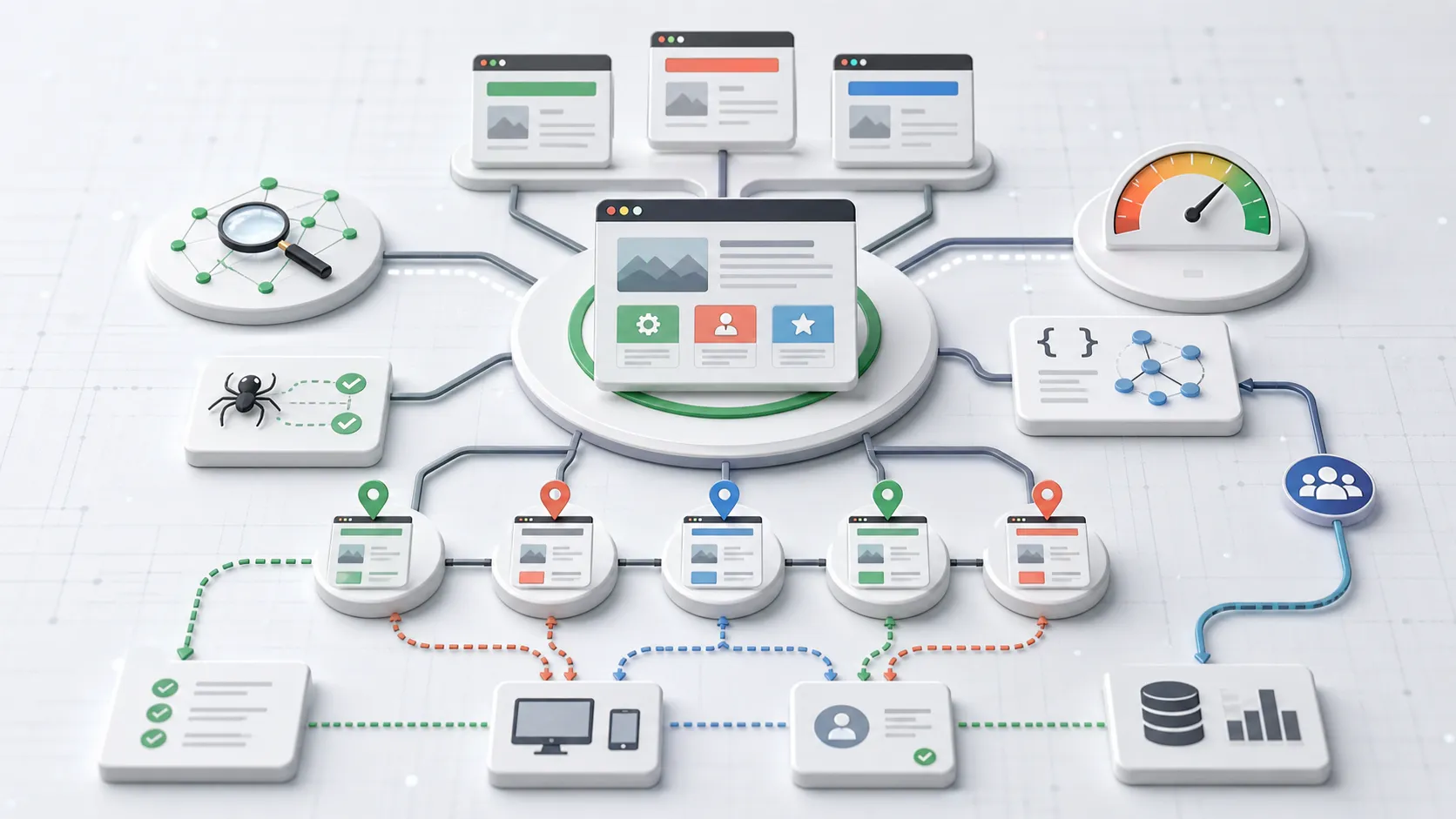
The best website architecture for SEO is a shallow, crawlable, internally linked system that helps users, search engines, and AI answer engines understand what the business offers and where it operates.
For service businesses, architecture is not just navigation. It is the structure that determines whether commercial pages can rank, whether local pages make sense, whether AI systems can extract trustworthy context, and whether visitors can become leads without friction.
Quick answer: The best SEO architecture for a service business uses a clear homepage, focused service hubs, location pages, local service spokes where justified, strong internal links, server-rendered content, structured data, and fast conversion paths.
What This Problem Really Means for a Business
Website architecture is a commercial variable. A business website is expected to work like a sales asset: it should attract qualified visitors, explain the offer, prove local relevance, and route people toward a next action. When the structure is weak, that system breaks.
The first problem is visibility. Search engines allocate crawl resources to every domain. If the site has deep URL paths, broken internal links, orphan pages, duplicated service content, or unclear categories, crawlers may never reach the pages that matter most. If those pages are not discovered and understood, they cannot compete for the searches that would have generated leads.
The second problem is conversion. A visitor who needs a local service is usually trying to answer simple questions quickly:
- Does this business offer the service I need?
- Does it serve my area?
- Can I trust it?
- What should I do next?
If the architecture forces that person through vague menus, slow pages, generic service lists, or isolated contact forms, friction increases. The result is not just a worse user experience. It is lost revenue.
Modern architecture also has a third audience: AI systems. Search is moving toward answer engines and generated summaries. Those systems need clear entity relationships, concise service definitions, structured data, and crawlable content. A site that looks good visually but hides its meaning in unstructured layouts or JavaScript-heavy app shells is harder for both search engines and AI systems to interpret.
Why Most Businesses Get This Wrong
Most businesses prioritize visual design before information architecture. The result is a polished site where important service pages are thin, buried, duplicated, or missing.
Common problems include:
- One generic services page trying to rank for every offer.
- One generic service areas page trying to rank for every city.
- Blog posts that never link to service pages.
- Location pages with no local proof.
- Menus that hide the most important commercial paths.
- JavaScript-heavy pages that crawlers and AI systems parse poorly.
A single consolidated services page is especially common. It may be fast to publish, but it gives search engines weak signals. A page that lists twenty services and ten cities does not have enough depth for any one service or location. It is broadly relevant to many things and strongly relevant to none.
The same problem appears in local SEO. A generic Service Areas page usually cannot capture meaningful city-level demand because it lacks local language, proof, internal links, schema, and conversion paths for each area. If a business wants to rank for a specific service in a specific city, the architecture must support that intent with a specific crawlable page where the value is justified.
The other common failure is ignoring AI-driven search. A site can publish a lot of content and still be hard for models to interpret if the business entity, services, locations, FAQs, and canonical resources are not clearly structured.
How to Diagnose the Issue
Before fixing architecture, run a crawl and map every important page by click depth, indexability, internal links, canonical status, and commercial intent. Tools such as Screaming Frog, Semrush Site Audit, Google Search Console, and server log analysis can show how bots and users move through the site.
Use the audit to find structural failure points:
| Diagnostic metric | What to check | Warning sign |
|---|---|---|
| Crawl depth | Number of clicks from the homepage to each important URL | Critical service or location pages sit more than three to four clicks deep. |
| Orphan pages | URLs that exist but have no inbound internal links | Valuable pages cannot be found through navigation or contextual links. |
| URL parameters | Dynamic strings such as ?id=123 or tracking/session parameters |
Duplicate URLs dilute authority and create indexation noise. |
| Internal link flow | Which pages receive the most internal authority | Low-value pages receive more links than commercial pages. |
| Index status | Search Console coverage and indexing reports | Important pages are discovered but not indexed. |
| Conversion path | User flows, events, form starts, and drop-offs | Visitors abandon before reaching contact, booking, or quote actions. |
Also inspect the page experience manually. If a user lands on a service page, can they reach the related location page, understand the offer, see proof, and take action without hunting? If not, the architecture is not doing its job.
What to Fix First
Fix the core hierarchy before creating more content. More pages will not help if authority, crawl paths, and user paths are already broken.
Start with:
- Homepage as the business and authority hub.
- Services hub for core offers.
- Individual service pages for each primary offer.
- Location hub for real service areas.
- Local service pages only where the business can support unique value.
- Contextual internal links between service, location, and article pages.
Important commercial pages should usually be reachable within three to four clicks from the homepage. That does not mean every page belongs in the main navigation. It means the site needs a logical path through navigation, hub pages, breadcrumbs, related sections, and body links.
URL structure should also be simple and stable. A deep path such as /company/divisions/marketing/services/seo/technical/audit creates needless complexity. A concise URL such as /services/seo-audit or a clear local pattern such as /locations/miami/seo-growth is easier for users, crawlers, and internal teams to understand.
When changing existing URLs, use permanent server-side redirects and update internal links. Architecture cleanup should not create broken paths or split ranking signals across old and new versions.
Shallow Architecture Beats Deep Architecture
Deep URL paths and buried pages make both crawling and conversion harder.

The goal is not to flatten everything into one page. The goal is to keep important pages close to the homepage and clearly connected.
Service Hubs and Local Spokes
For a local or regional service business, the best structure usually combines service hubs with local relevance.

Not every service-city combination deserves a page. Create local spokes only when the business can support them with real local relevance, useful content, and a conversion path.
Good local spokes usually include:
- A specific service and city pairing.
- A clear explanation of the local problem.
- Proof, examples, or service details relevant to that area.
- LocalBusiness, Service, FAQPage, WebPage, and BreadcrumbList schema where appropriate.
- Links back to the parent service hub and location hub.
- A direct contact, booking, audit, or quote path.
Avoid creating hundreds of near-duplicate pages with city names swapped into the same template. Programmatic SEO can work, but only when each page contains enough unique local value to deserve indexation.
Internal Linking
Internal links are the architecture in action.
Use links to connect:
- Homepage to core services.
- Service pages to related articles.
- Articles to relevant service pages.
- Location pages to relevant services.
- Case studies to services and locations.
- FAQs to deeper implementation guides.
Avoid orphan pages. If a page matters, another important page should link to it contextually.
Hub-and-spoke internal linking protocol
The hub page should introduce the category and link to specific spokes. Spoke pages should link back to the hub and sideways to closely related pages. Articles should support the commercial page that best matches the topic.
This keeps authority and context moving through the site instead of trapping it in isolated posts.
For example, a service hub for SEO growth should link to technical SEO, local SEO, programmatic SEO, and AI search optimization pages if those are real offers. Each spoke should link back to the SEO hub and to tightly related resources. A blog post about structured data should link to the technical SEO or SEO growth service page rather than ending as an isolated article.
Use descriptive anchor text, but avoid forcing exact-match anchors everywhere. Natural variations are safer and more useful:
- SEO growth strategy
- local SEO service pages
- technical SEO audit
- website architecture review
- AI search optimization
Technical SEO Considerations
Architecture also depends on technical implementation.
| Requirement | Why it matters |
|---|---|
| Static or server-rendered content | Crawlers and AI systems can read content immediately. |
| Clean URL structure | Users and bots understand page purpose faster. |
| Breadcrumbs | Clarifies hierarchy and improves navigation. |
| Canonicals | Prevents duplicate versions of the same page. |
| Schema | Defines services, locations, articles, FAQs, and business identity. |
| Fast pages | Improves crawl efficiency and conversion. |
Deep JSON-LD schema implementation
Schema should reflect the architecture. The homepage can define the business. Service pages can define offers. Location pages can define geographic relevance. Articles can define expertise and connect back to services.
| Schema type | Where it belongs | Strategic value |
|---|---|---|
| LocalBusiness | Homepage and local landing pages | Defines name, address, phone, service areas, ratings, and entity identity. |
| Service | Individual service pages | Describes the offer, provider, audience, area served, and commercial intent. |
| FAQPage | Service, category, and article pages with real FAQs | Structures common questions for search and answer engines. |
| BreadcrumbList | Across the site | Reinforces hierarchy and helps users move upward. |
| Article | Insight and blog content | Defines author, publish date, topic, and content identity. |
Schema should not invent relationships the visible site does not support. If the page says the business serves Miami, the internal links, location pages, service content, and structured data should all agree.
Core Web Vitals and latency optimization
Architecture fails if every page is slow. Keep high-intent service and local pages fast, stable, and server-readable.
Focus on:
- Largest Contentful Paint: load the primary above-the-fold content quickly.
- Interaction to Next Paint: keep menus, forms, buttons, and chat interactions responsive.
- Cumulative Layout Shift: reserve space for images, embeds, banners, and forms so the layout does not jump.
Headless architecture and payload management
Headless or component-driven sites can work well when public pages still ship clean HTML. Avoid sending users and crawlers an app shell when the page is primarily marketing content.
For service-business websites, static generation or server rendering is usually a strong fit. The user gets fast HTML, search engines get immediate content, and the business can still use modern components for forms, chat, analytics, personalization, and CRM integrations.
Website Development Considerations
The implementation stack matters because architecture is not just a sitemap. It is also how content is rendered, cached, linked, and updated.
Strong development choices include:
- Static or server-rendered public pages for services, locations, articles, and landing pages.
- Clean component systems that reuse navigation, CTAs, FAQs, service cards, and schema helpers.
- Predictable URL helpers so internal links stay consistent.
- Image optimization for hero images, diagrams, and article assets.
- Edge caching or CDN delivery for fast response times.
- Lightweight client-side JavaScript for interactions that actually need it.
Avoid making the public marketing site behave like a private dashboard. A service page should not require a large JavaScript payload before the content is visible. Crawlers, AI systems, and users should all receive the core page meaning quickly.
Conversion Considerations
An architecture optimized only for crawlers is incomplete. It also needs to turn qualified visits into conversations, audits, bookings, or sales opportunities.
High-intent service and local pages should include:
- A visible primary CTA.
- A short path to contact or booking.
- Service-specific proof.
- Clear pricing context or process expectations where appropriate.
- FAQs that reduce buying friction.
- Links to supporting articles or case studies.
- Mobile-friendly click-to-call or form actions.
The user should not need to leave a service page and hunt through a generic Contact page to take action. The architecture should move from intent to proof to conversion on the same path.
Consistency also matters. Navigation labels, button styles, form placement, and link styling should remain predictable across the site. Familiar patterns reduce cognitive load, especially on mobile.
AI Automation Opportunities
Architecture should connect discovery to operations. A lead from an SEO page can carry page, location, service, and campaign context into a CRM.
Useful automation includes:
- AI chatbots that read the page context.
- Trigger-based CRM handoffs.
- Owner alerts by service and location.
- Follow-up sequences based on page intent.
- Content audits that identify orphan or stale pages.

The most useful automations depend on clean architecture. If a form submission includes the page, service, location, campaign, and user question, the CRM can route the lead more intelligently. If a chatbot understands the current page context, it can qualify the visitor without asking redundant questions.
GEO, AEO, and AI-Readable Paths
AI answer engines need deterministic structure. A shallow hierarchy, schema, breadcrumbs, and concise service definitions help models understand which page answers which question.
The emerging llms.txt convention can support that structure by pointing agents to clean, canonical resources. It is similar in spirit to robots.txt, but the purpose is different. robots.txt primarily controls crawler access. llms.txt is designed to guide AI systems toward useful, machine-readable content.
For a marketing site, llms.txt does not replace normal pages. It complements them. The public website still needs fast HTML, schema, internal links, and strong page content. AI-readable files can help agents understand the business without crawling every decorative page.
Markdown is useful here because it is lightweight and semantically simple. A business can expose concise Markdown resources that summarize services, locations, policies, documentation, or knowledge base material. More advanced architectures may also use an llms-full.txt file as a broader clean-feed resource for high-value content.
The key rule: AI-readable files should point to the same truth as the website. They should not contradict service pages, location pages, schema, or the business profile.
How a Technical Consultant Approaches This for a Service Business
The practical approach is:
- Optimize the homepage as the local authority and category hub.
- Align primary services with the real business model.
- Build secondary service and city spokes only where justified.
- Add contextual links between hubs, spokes, articles, and CTAs.
- Add schema and breadcrumbs that mirror the visible structure.
- Connect high-intent pages to qualification and CRM workflows.
Step 1: Optimize the homepage as the local authority hub
The homepage should clearly define the business entity. It needs to state the primary service category, core market, service area, credibility signals, and next action. It should also act as a routing page to services, locations, proof, and contact paths.
For a local business, the homepage should align with the primary Google Business Profile category and core geographic footprint. The first section should make the business identity obvious without relying on vague brand language.
Step 2: Reflect real service categories
Many businesses underuse their service categories. If the business offers SEO, web development, and AI automation, the architecture should not hide those behind a single generic services page. Each meaningful category should have a page or hub with enough detail to support search intent and conversion.
This does not mean every small task needs a page. It means the site structure should mirror how buyers search and how the business actually sells.
Step 3: Build service and location spokes carefully
Service spokes should be specific enough to rank and convert. They should explain the problem, the method, the deliverable, proof, FAQs, and the next action.
Location spokes should exist only when there is a real reason for them. Useful local pages can include neighborhood language, local service constraints, examples, reviews, maps, or operational details. Thin city-name swaps are not enough.
Step 4: Use programmatic SEO only with quality controls
Programmatic SEO can support service-area scale when the business has many real locations, categories, or repeatable page patterns. But the architecture needs strict controls:
- Stable URL templates.
- Unique local or service-specific content blocks.
- Canonical rules.
- Internal links from relevant hubs.
- Schema that matches each page.
- A clear noindex or exclusion policy for weak pages.
The goal is not to generate the maximum number of URLs. The goal is to generate the maximum number of useful, indexable, commercially relevant pages.
Mistakes to Avoid
- Publishing many thin local pages with no local usefulness.
- Using a single service areas page for every city.
- Burying commercial pages behind abstract navigation labels.
- Creating articles that do not support a service path.
- Ignoring click depth and orphan pages.
- Treating AI-readable files as a substitute for good HTML architecture.
- Flattening every URL into the root with no semantic folders.
- Enforcing rigid silos that prevent useful cross-links.
- Using over-optimized exact-match anchor text everywhere.
- Publishing schema that does not match visible page content.
- Letting JavaScript hide core service content.
- Sending all CTAs to the same generic contact page with no context.
- Creating
llms.txtor Markdown resources that drift from the live site.
Practical Checklist
| Area | Action |
|---|---|
| Foundation | Keep critical pages within three to four clicks from the homepage. |
| URLs | Use clean, stable, descriptive URLs without unnecessary parameters. |
| Homepage | State business category, services, locations, proof, and primary CTA. |
| Services | Give each core service a focused page or hub. |
| Locations | Create real location pages for meaningful service areas. |
| Local services | Add service-location pages only when there is enough unique value. |
| Links | Connect hubs, spokes, articles, proof, and services contextually. |
| Schema | Add LocalBusiness, Service, FAQPage, WebPage, Article, and BreadcrumbList as appropriate. |
| Performance | Keep commercial pages fast, stable, cached, and server-readable. |
| AI/GEO | Use llms.txt and Markdown resources to support, not replace, crawlable pages. |
| Conversion | Connect high-intent pages to booking, audit, chat, or CRM workflows. |
Final Recommendation
The best SEO architecture is simple, explicit, and commercially useful. It avoids both extremes: a thin one-page services list and a bloated maze of low-value pages.
For service businesses, build the site around how buyers search: service, location, proof, process, and next action. Then use schema, internal links, fast rendering, AI-readable resources, and automation workflows to make that structure understandable to both people and machines.
A website should no longer function as a static brochure. It should act as a structured growth system: discoverable in search, understandable to AI answer engines, persuasive to visitors, and connected to the operations that turn interest into revenue.
Works Cited
- How to Build an AEO and GEO Strategy for AI-Optimized Websites
- Website Architecture for SEO: The Complete Guide
- Site Architecture for SEO: Structure That Ranks and Scales
- How to Structure a Website for a Local Service Business
- Local SEO Landing Pages for WordPress
- Designing for AI: How to Structure your Website so AI Search Engines Love it
- Website Architecture: Best Practices for SEO Site Structures
- Website Architecture and Internal Links
- Blueprint for Building a Perfect Website Structure for Local SEO
- The llms.txt file
- The Complete Guide to llms.txt: Control How AI Crawlers Access Your Content
- What is llms.txt?
- The Ultimate llms.txt Guide: Make Your Website LLM-Ready
- What Is LLMs-full.txt? Your Guide to Controlling AI Crawlers